It was October 9, 1944, that the post-World War II future of Greece was decided between the leaders of Great Britain and the Soviet Union, who met secretly in Moscow. Their aim was to determine which countries would fall under their spheres of influence after the end of World War II. Winston Churchill and Joseph Stalin met for the so-called Tolstoy Conference (or Moscow Conference) to discuss the future governments of the Balkan countries and Poland, which they had liberated from German occupation.
Although World War II had not yet ended, it was clear that the Allied forces were close to defeating Germany. German troops were gradually abandoning the countries they had occupied. On October 12, the occupying forces left Athens and moved north, ending a brutal three-and-a-half-year occupation.
Only three days before the Wehrmacht’s departure from Greece, the country’s future was already on the negotiating table between the two powers. The cannons of World War II had not yet fallen silent, but the future of the Balkans was being secretly discussed by these two powerful leaders and the US ambassador.
Germany surrendered on April 16, 1945, while Adolf Hitler refused to surrender and killed himself on April 30. On May 7 and 8, Germany signed an unconditional surrender. Even while the war was still ongoing and Germany was attempting to fight back, these powerful leaders were dividing their spoils, confident that victory was imminent. They decided the post-World War II future of Greece and the Balkans months before the war officially ended.
The future after World War II
While nothing had yet been decided on the war fronts, as Nazi forces were attempting a counteroffensive, the leaders of Britain, the United States, and the Soviet Union knew they needed to reach an understanding for the postwar era in Europe and the world. No one wanted to lead the Old Continent into another war following Germany’s defeat.
It was clear that the ideological, social, and political differences that had divided Western and Eastern Europe before the outbreak of World War II would not simply disappear once the war ended. The three great powers of the time, seeing that Hitler’s downfall was imminent and that sooner or later the “next day” would arrive, agreed to sit down at the negotiating table to prevent any possibility of a new conflict.
The post-World War II negotiating table and Greece
In the meeting between Churchill and Stalin, the United States was represented by US ambassador to Moscow Averell Harriman, serving as an observer, and the head of the US military mission in Moscow, General John Dean. As far as Churchill was concerned, the two allies were meeting to set a timetable for Russia’s entry into the war against Japan, an issue he had raised eleven months earlier.
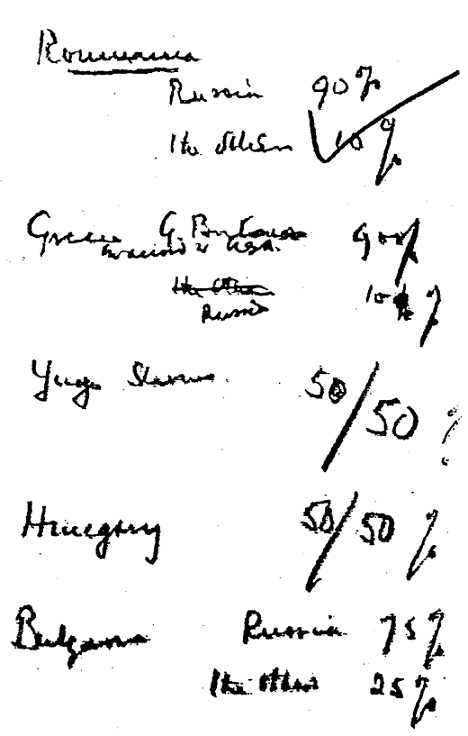
However, Stalin was focused on establishing the balance of power and spheres of influence that the two countries would have in the Balkans after World War II. Churchill wrote out a list on a piece of paper dividing Romania, Greece, Yugoslavia, Hungary, and Bulgaria between the Allied powers, and Stalin simply placed a checkmark next to Churchill’s suggestions.
The Soviet Union came out very favorably in the agreement, gaining 90 percent of Romania, 10 percent of Greece, half of Yugoslavia, half of Hungary, and three-quarters of Bulgaria. Churchill’s primary interest was Greece, and with Stalin’s approval, he instructed his staff that British forces could be dispatched there.
The future of Poland was also discussed. Churchill proposed a meeting between the leader of the exiled Polish government, based in London, and the Soviets to determine a Polish-Soviet frontier, but the proposal ultimately went nowhere.
The Churchill memoirs
In his memoirs, British Prime Minister Winston Churchill recalled the moment during the October 1944 Moscow Conference, when he decided it was the right time to negotiate with Stalin the post-World War II division of influence in the Balkans, including that of Greece:
“I considered the moment to act appropriate. I declared: ‘Let us regulate our affairs in the Balkans. Your troops are in Romania and Bulgaria. We have interests, missions, agents in these countries. Let us avoid conflict over trivial matters,’” Churchill told Stalin.
Churchill continued:
“To Great Britain and Russia, what would you say about a 90 percent advantage for you in Romania, a 90 percent advantage for us in Greece, and an equal 50 percent share in Yugoslavia” While Churchill’s speech was being translated, he wrote on half a sheet of paper:
ROMANIA
Russia 90%
The other 10%
GREECE
Great Britain (in agreement with the USA) 90%
Russia 10%
YUGOSLAVIA 50% and 50%
HUNGARY 50% and 50%
BULGARIA
Russia 75%
The other 25%
Churchill pushed the paper in front of Stalin, who had in the meantime been given the translation. There was a short pause. Then Stalin took his blue pencil, drew a thick line as a kind of approval, and returned the note to Churchill. Everything had been settled in the brief time it took Churchill to write the note.
The paper with the blue line remained on the table. Finally, Churchill said: “Wouldn’t they consider it somewhat cynical of us to settle these problems, on which the fate of millions of lives depends, in such a haughty manner? Let’s burn this paper.”
“No, keep it,” insisted Stalin.
Greece and the Balkans divided between the Soviet Union and Britain post-World War II
When the two leaders finished their discussion, the Foreign Ministers of Britain and the Soviet Union—Anthony Eden and Vyacheslav Molotov—took over to negotiate the final percentages of influence. The outcome of this follow-up meeting was an increase in the Soviet Union’s share of influence in Bulgaria and Hungary to 80 percent, effectively bringing the chapter on “post-war Europe” to a close even before World War II had officially ended.
What is particularly important to emphasize is that official Soviet accounts never questioned whether these events actually took place—not even the division of influence written on the infamous scrap of paper. What Soviet historians consistently denied, however, was that Stalin had ever agreed with what Churchill proposed and recorded.