








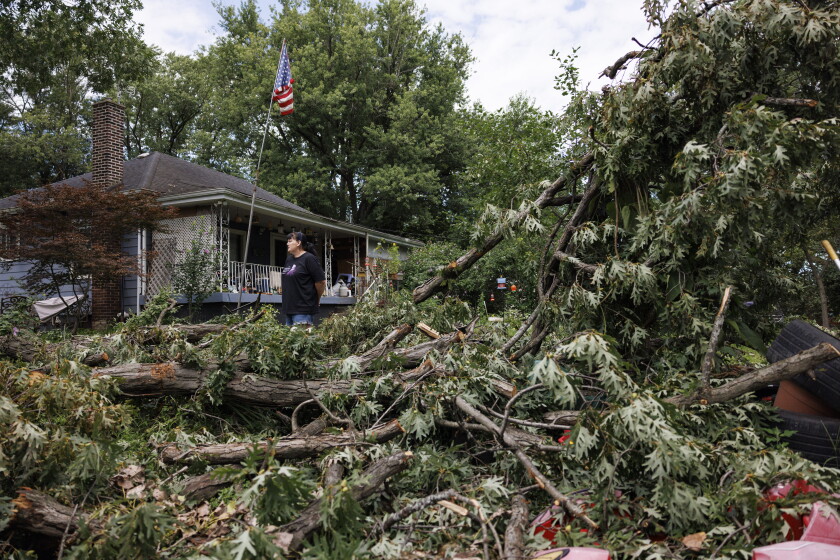
<p><i>This story was originally published in</i><a class="Link" href="https://gary.capitalbnews.org/gary-power-outage-derecho-storm/" target="_blank" ><i> Capital B Gary</i></a><i>.</i></p><p>A 99 mph wind gust — comparable to a Category 2 hurricane — tore through Gary on Aug. 11, battering neighborhoods and knocking out power to nearly 38,300 utility customers in the city.</p><p>Ten days later, about 20,000 NIPSCO customers remained without electricity . That’s nearly half of the roughly 43,000 customers still without power across Northwest Indiana at that time.</p><p>The power company has said Gary experienced the most widespread outage of any community in its Indiana territory. The utility was targeting 11:59 p.m. Tuesday for full restoration in Gary, making the city one of the last Northwest Indiana communities expected to have power fully restored.</p><p>But wind speed alone doesn’t explain how the storm — classified as a <a class="Link" href="https://www.weather.gov/lmk/derecho" target="_blank" >derecho</a> — could leave so much of a city without electricity for nearly two weeks.</p><p>Atmospheric and environmental researchers say the devastation resulted from a punishing combination: unusually broad and sustained straight-line winds sweeping across rain-saturated soil, uprooting trees that then crashed into an electrical system heavily dependent on overhead power lines. The scale of the damage also raises a longer-term question: What investments can make electrical systems more resilient to severe storms?</p><h3>A different kind of wind</h3><p>Dan Chavas, a Purdue University atmospheric science professor who leads the Purdue Extreme Weather Laboratory, said a derecho’s broad reach helps explain how one storm could cause damage across so much of Northwest Indiana.</p><p>“Typically, a tornado will be swirling over a relatively small area, and it can be quite violent, something like 200 miles an hour,” Chavas said. A derecho, by comparison, can produce somewhat weaker winds across a much broader area.</p><p>“This one in particular, which was something like 70 to 100 miles an hour, but over a much broader area so you’re impacting a much larger footprint,” Chavas said.</p><p></p><p>That’s how the storm played out across the city. The wind didn’t rip through homes and buildings the way tornadoes did in Gary <a class="Link" href="https://gary.capitalbnews.org/gary-tornado-damage/" target="_blank" >last year</a>. Instead, widespread straight-line winds swept across the city, exerting sustained force on thousands of trees at once.</p><p>But wind was only part of the equation. What was happening beneath those trees mattered, too.</p><p>Sarah Mincey, an environmental resilience researcher at Indiana University’s Environmental Resilience Institute, has studied Northwest Indiana’s tree canopy, which NiSource Utilities executive Melody Birmingham identified as a factor in the city’s extended restoration period.</p><p>Canopy cover measures the share of an area covered by tree branches when viewed from above. Researchers use aerial imagery to calculate it. Her study, done in partnership with Davey Resource Group and funded by a grant from the USDA Forest Service, analyzed coverage around the region.</p><p>Gary’s average canopy coverage was about 28%, Mincey said. That is not unusually high for a city.</p><p>“Many cities get up more into the 30s and 40s percent canopy cover,” Mincey said. By comparison, researchers measured Hammond’s canopy coverage at about 16% in 2025.</p><div class="Enhancement" data-align-center>
<div class="Enhancement-item" data-crop="">
<figure class="Figure"><a class="AnchorLink" id="image-450000" name="image-450000"></a>
<picture data-crop="medium">
<source type="image/webp" width="490"
height="275"
data-srcset="https://cst.brightspotcdn.com/dims4/default/84c49a2/2147483647/strip/true/crop/6122×3436+0+324/resize/490×275!/format/webp/quality/90/?url=https%3A%2F%2Fchorus-production-cst-web.s3.us-east-1.amazonaws.com%2Fbrightspot%2F7c%2F7a%2Ff40dca75447ea00cbfc9e0537b5c%2Fgarypower-260818-11.jpg 1x,https://cst.brightspotcdn.com/dims4/default/2814fae/2147483647/strip/true/crop/6122×3436+0+324/resize/980×550!/format/webp/quality/90/?url=https%3A%2F%2Fchorus-production-cst-web.s3.us-east-1.amazonaws.com%2Fbrightspot%2F7c%2F7a%2Ff40dca75447ea00cbfc9e0537b5c%2Fgarypower-260818-11.jpg 2x" data-lazy-load="true" srcset="data:image/svg+xml;base64,PHN2ZyB4bWxucz0iaHR0cDovL3d3dy53My5vcmcvMjAwMC9zdmciIHZlcnNpb249IjEuMSIgaGVpZ2h0PSIyNzVweCIgd2lkdGg9IjQ5MHB4Ij48L3N2Zz4="
/>
<source width="490"
height="275"
data-srcset="https://cst.brightspotcdn.com/dims4/default/3310e2b/2147483647/strip/true/crop/6122×3436+0+324/resize/490×275!/quality/90/?url=https%3A%2F%2Fchorus-production-cst-web.s3.us-east-1.amazonaws.com%2Fbrightspot%2F7c%2F7a%2Ff40dca75447ea00cbfc9e0537b5c%2Fgarypower-260818-11.jpg" data-lazy-load="true" srcset="data:image/svg+xml;base64,PHN2ZyB4bWxucz0iaHR0cDovL3d3dy53My5vcmcvMjAwMC9zdmciIHZlcnNpb249IjEuMSIgaGVpZ2h0PSIyNzVweCIgd2lkdGg9IjQ5MHB4Ij48L3N2Zz4="
/>
<img class="Image" alt="An uprooted tree on the 3600 block of Burr Street in Gary." srcset="https://cst.brightspotcdn.com/dims4/default/3310e2b/2147483647/strip/true/crop/6122×3436+0+324/resize/490×275!/quality/90/?url=https%3A%2F%2Fchorus-production-cst-web.s3.us-east-1.amazonaws.com%2Fbrightspot%2F7c%2F7a%2Ff40dca75447ea00cbfc9e0537b5c%2Fgarypower-260818-11.jpg 1x,https://cst.brightspotcdn.com/dims4/default/5438a78/2147483647/strip/true/crop/6122×3436+0+324/resize/980×550!/quality/90/?url=https%3A%2F%2Fchorus-production-cst-web.s3.us-east-1.amazonaws.com%2Fbrightspot%2F7c%2F7a%2Ff40dca75447ea00cbfc9e0537b5c%2Fgarypower-260818-11.jpg 2x" width="490" height="275"
data-src="https://cst.brightspotcdn.com/dims4/default/3310e2b/2147483647/strip/true/crop/6122×3436+0+324/resize/490×275!/quality/90/?url=https%3A%2F%2Fchorus-production-cst-web.s3.us-east-1.amazonaws.com%2Fbrightspot%2F7c%2F7a%2Ff40dca75447ea00cbfc9e0537b5c%2Fgarypower-260818-11.jpg" data-lazy-load="true" src="data:image/svg+xml;base64,PHN2ZyB4bWxucz0iaHR0cDovL3d3dy53My5vcmcvMjAwMC9zdmciIHZlcnNpb249IjEuMSIgaGVpZ2h0PSIyNzVweCIgd2lkdGg9IjQ5MHB4Ij48L3N2Zz4="
>
</picture>
<div class="Figure-content"><figcaption class="Figure-caption"><p>Saturated soils make it more likely that heavy winds will take down trees, experts say.</p></figcaption><span class="line"></span><div class="Figure-credit"><p>Anthony Vazquez/Sun-Times</p></div></div>
</figure>
</div>
</div><p>The problem, then, isn’t simply the trees. The condition of the ground matters.</p><p>Mincey pointed to a 2018 climate impacts assessment her institute is currently updating, which found Indiana’s precipitation is trending not just more frequent but more intense.</p><p>“I think what’s significant to the story is that there is just heavier precipitation,” she said.</p><p>“So, it’s not just that there’s more frequency of rain events, but they’re heavier, extreme precipitation,” Mincey said. “So heavy rainfall events, heavy downpours are going to contribute to massive saturation of the soils. And when our soils get saturated like that, we have heavy wind, then we have a sail-like factor happening with the canopy of the trees.”</p><p>Mincey added that in urban areas like Gary, trees already work with less room to anchor themselves than trees in less-developed areas.</p><p>“Typically, in urban areas like Gary, you have limited rooting space for those trees,” she said, pointing to sidewalks, roads and buried utility lines that constrain and sometimes damage root systems over time.</p><p>She stressed that though the benefits of tree canopy — including stormwater diversion, urban cooling and cleaner air — are clear, regular maintenance, good tree care and infrastructure management are key.</p><h3>Preparing the grid for the next storm</h3><p>A harder and potentially more expensive question is what, if anything, could limit the damage from storms like this in the future.</p><p>Emmanouil Anagnostou, a board of trustees distinguished professor of environmental engineering at the University of Connecticut who has worked with utilities across the country on storm preparedness, laid out how that preparation generally works.</p><p>“Typically utilities, the majority of their distribution lines are overhead,” Anagnostou said. “And overhead power lines, the age and also the vegetation around them, affects or interacts with the severe weather.”</p><p>That leaves utilities with several potential approaches to reducing risk, including vegetation management, strengthening poles and other equipment, creating greater redundancy in the electrical system and, in some cases, burying power lines.</p><p>Moving electrical lines underground, however, comes with an enormous price tag.</p><p>Sam Gomberg, associate director of climate and energy at the Union of Concerned Scientists, said underground electrical lines can cost seven to 10 times as much as installing poles and overhead wires. Anagnostou similarly described widespread undergrounding as cost-prohibitive.</p><p>But burying power lines is not the only way utilities can make their systems more resilient.</p><p>Gomberg said utilities can also build greater redundancy into their systems, creating alternative routes for delivering electricity when transmission or distribution infrastructure is damaged. That could allow portions of the system to continue operating, or power to be restored more quickly, while damaged infrastructure is repaired, he said.</p><p>Anagnostou said there is no single solution for protecting electrical systems against severe weather. Utilities have to weigh the costs of strengthening infrastructure against the likelihood and potential consequences of different types of storms.</p><p>“Every utility has to look at this holistically over a period of several years,” Anagnostou said.</p><p>For some extreme storms, he said, the better investment may be in preparation and response, including ensuring enough crews are ready to deploy quickly and restore service after widespread outages.</p>
How 99 mph winds left Gary in the dark for nearly two weeks 2026
IUSTITIA.BG – Investigations 2009-2026 2026-08-23 10:52:01
Latest news World news Country news Most important news latest news most important latest of the day Justice Petar Nizamov Feathers Petar Nizamov- Feathers Justice bg iustitia.bg iustitia iusticia usticia investigation Burgas Bulgaria news news of the last hour news of the day news of today Bulgaria news The news from Bulgaria blitz news top news most important most commented latest news Boyko Borisov news weather coronavirus news news weather facebook youtube facebook instagram news today news of the last minutes news today today news news bg news leading news hot news bg news site for news all news news bg news of the last hour latest latest news bg news of today news today news today news of the last hour latest news today news bg news news 24 hours news vesti bg novini news world bird bg bivol bg bivol trud bg novini latest news today novinite bg news hello bulgaria political party coat of arms delyan peevski scandalous Bulgarian National Television Free Europe Television scandal exclusive live tv live right now tv tv online tv program bg live now tv news online tv online live court Burgas court Burgas district court Burgas court Burgas district court Burgas district court Burgas appellate court Burgas prosecutor Burgas prosecutor’s office Burgas district prosecutor’s office Burgas district prosecutor’s office Burgas district prosecutor’s office Burgas district prosecutor’s office Burgas district prosecutor’s office Burgas district prosecutor’s office Prosecutor General Ivan Geshev Prosecutor Geshev Tsatsarov Ministry of Internal Affairs Burgas ODMR Burgas ODPR Burgas police Burgas district police Burgas prosecutor Tsatsarov SGS cases Varna court chairman of the SGS court decisions on civil cases decisions on cases Plovdiv court decision of the court decisions cases Varna court criminal cases district district court decisions work in the court SGS chairman of the SGS judges Sofia court post judges Plovdiv court Plovdiv judges Plovdiv Supreme Court Inspectorate Supreme Court Supreme Judicial Council lawyer lawyer criminal cases lawyer civil cases lawyer marriage cases lawyer administrative criminal law criminal process civil law civil process administrative law constitutional law

Гладни ли сте? Mr. PER е на път!
Скара на истински дървени въглища, прясно приготвена храна и удобна онлайн поръчка в Бургас.
🔥 Mr. PER – Краснодар
Централен пазар „Краснодар“
ул. „Св. Климент Охридски“ № 49
Бургас
🔥 Mr. PER – Меден рудник
Третата спирка, блок 46
ж.к. Меден рудник
Бургас
Истински въглища. Истински вкус. В Бургас!
skaranadarvenivaglishta.com