







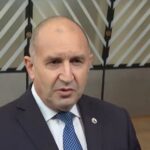
Prime Minister Roumen Radev said on November 26 that European Commission’s proposal that Bulgaria be fined for its excessive budget deficit is unfair, given the country’s efforts to improve public finances and that other EU countries are also in an excessive deficit procedure but are failing to reduce it.
Radev, speaking to reporters on arrival for a special two-day meeting of the European Council said that Bulgaria was the first for which such a fine is proposed under the new European rules, and he described the reasons as procedural, not political.
“I see purely procedural reasons, because for the first time there is a change in the rules for sanctioning, and for the first time this is happening precisely with the arrival of the Bulgarian budget,” Radev said.
“Don’t forget that this is not a standard budget, it came in August. That’s how we found ourselves – the change in the political situation, the elections in April, a new government in May, a budget only at the end of July,” he said.
“So for the first time our budget encountered a change in the rules. And they are that the fines were much larger. Over 10 times larger and many countries before us had excessive deficits and they were sanctioned under this old procedure,” Radev said.
“But because it has a large ceiling on fines, it has never come to actual fining. Now the ceiling is very low, you know, 0.02 per cent. But we are the first country to come with an excessive deficit under these new rules.”
This fine is “symbolic” in financial terms, Radev said.
“But it is of course reputational and is used with great enthusiasm by the opposition in Sofia, which is actually the reason we got here.”
Under no circumstances will we fulfill the opposition’s nihilistic dreams of having European funds and payments under the Recovery and Resilience Plan stopped, he said.
“There is no question of this at all and it will definitely not happen. Because Bulgaria is very clearly implementing a strict financial policy in our face and this is appreciated. There can be no question of any suspension of EU funds. This is a standard procedure that was necessary due to an excessive deficit and exactly at the moment when our budget was released. So things are clear there.”
According to Radev, the European Commission gave a positive assessment of the government’s measures for the 2027 Budget.
“That is, the assessment of our Budget, which we are making for 2027, is positive and encouraging, that Bulgaria, with the measures taken in this budget, is already starting to significantly reduce its deficit,” Radev said.
“Otherwise, it is unfair, it is unfair, because we have the largest gradient of deficit reduction from 2026 to 2027. And I expect that there will still be reason here, because we should be encouraged for reducing the deficit with such a gradient, while there are other countries that simultaneously have an excessive deficit and fail to reduce it at all. The procedure will be activated for them next year as well.”
The European Commission must analyse its abilities to realistically assess the financial situation in the member states, Radev said.
“Why did the European Commission suddenly find that Bulgaria has such an excessive deficit?” he said.
“How did it suddenly find that we have macroeconomic imbalances? But excuse me, these macroeconomic imbalances do not happen in three months, nor in six months. They accumulate over years.
“How did the Commission now find out that budget funds are being spent indiscriminately in Bulgaria, without the necessary control? How did Bulgaria suddenly, in April and May of last year, lower its inflation enough for the convergence report to be published,” he said.
“And in August, inflation again went beyond any criteria. There are things here that the European Commission must analyse in terms of its ability to realistically assess the financial situation in the member states. If it does not do so, it means that there are political motives, not economic ones, behind our admission to the euro zone.”
Radev commented on what Bulgaria’s position will be in discussing the EU budget.
“There are three important pillars of our demands,” he said.
“First of all, we must not back down from cohesion, we know that this is the main instrument for the unity of the union, for the economic development of the union.
“Second, we insist on clear financial support for the Black Sea region, and not just mentioning it. We all know how much countries like Bulgaria and Romania are involved in the actions in the Black Sea, especially with the attacks on merchant ships,” he said.
“These are significant costs for us and they must be taken into account. Next, this is the refusal of own resources based on the European emissions trading system and tobacco excise duties. For us, this approach is unacceptable because it harms Bulgaria disproportionately. These are our lines of action under this budget.”
“What we are negotiating with President Antonio Costa is a plus for Bulgaria. At least as far as our income in the European budget is concerned. And the amount is not small at all, so I really hope we can find a good balance that will benefit our country.”
He was skeptical that an understanding will be reached on November 26.
“There are many contradictions that we need to iron out. But I rely on the will and responsibility of all member states so that we can reach a consensus. Our view is that the budget must be achieved within this year. So that from 2028 we can already work on this new financial framework.”
Bulgaria wants to implement a new approach to the Ukrainian loan, as Bulgaria is ready to be included in the budget for non-military support, Radev said.
“I want there to be a very clear difference between Bulgaria and Czechia, Slovakia and Hungary. Czechia, Slovakia and Hungary have refused from the very beginning and are not part of the countries that guarantee this loan. From the very beginning. Both 2025 and 2026. They said ‘no’ from the very beginning and are not.”
“While the government of Zhelyazkov and then confirmed by the government of Gyurov, we have so far been guarantors of two loans – 45 billion from last year, 45 billion from this year,” he said.
“That is, Bulgaria has already undertaken to be a guarantor for a loan of 90 billion and we pay the interest within the framework of the general European budget on these loans,” Radev said.
“The question is from now on for next year, the request for another 45 billion for a loan. At our explicit insistence, and I am glad that this is already being accepted by the European institutions and by Antonio Costa, we will also talk today with Mrs. Von der Leyen, but she has already expressed support for our position that this loan is divided into two components.
Twenty-five billion euro goes to military support and 20 billion for budgetary non-military support, he said.
“We are ready to join in non-military support and with a clear request that our support as guarantors go specifically targeted to the areas with a compact Bulgarian population from our historical community,” he said.
“We have over 300 000 Bulgarians in Ukraine. They need healthcare, they need heating, electricity, transport, so I hope the European Commission will accept our approach, which we will insist on, because we, on the other hand, cannot abdicate from our obligations as a state and as a society to our historical diaspora, to our compatriots in Ukraine.”
Radev also commented on the EC’s request to ban Russian athletes from participating in competitions in Europe, as part of the proposed 22nd package of sanctions against Moscow.
“Not just about athletes. We’re also talking about tourism related to sports events and activities, even cultural events. And I think we’re going too far to politicise sports and cultural events in this way. So we have our reservations there,” Radev said.
PM Radev says EC’s proposal that Bulgaria be fined over excessive deficit is unfair 2026
IUSTITIA.BG – Investigations 2009-2026 2026-11-25 23:36:39
Latest news World news Country news Most important news latest news most important latest of the day Justice Petar Nizamov Feathers Petar Nizamov- Feathers Justice bg iustitia.bg iustitia iusticia usticia investigation Burgas Bulgaria news news of the last hour news of the day news of today Bulgaria news The news from Bulgaria blitz news top news most important most commented latest news Boyko Borisov news weather coronavirus news news weather facebook youtube facebook instagram news today news of the last minutes news today today news news bg news leading news hot news bg news site for news all news news bg news of the last hour latest latest news bg news of today news today news today news of the last hour latest news today news bg news news 24 hours news vesti bg novini news world bird bg bivol bg bivol trud bg novini latest news today novinite bg news hello bulgaria political party coat of arms delyan peevski scandalous Bulgarian National Television Free Europe Television scandal exclusive live tv live right now tv tv online tv program bg live now tv news online tv online live court Burgas court Burgas district court Burgas court Burgas district court Burgas district court Burgas appellate court Burgas prosecutor Burgas prosecutor’s office Burgas district prosecutor’s office Burgas district prosecutor’s office Burgas district prosecutor’s office Burgas district prosecutor’s office Burgas district prosecutor’s office Burgas district prosecutor’s office Prosecutor General Ivan Geshev Prosecutor Geshev Tsatsarov Ministry of Internal Affairs Burgas ODMR Burgas ODPR Burgas police Burgas district police Burgas prosecutor Tsatsarov SGS cases Varna court chairman of the SGS court decisions on civil cases decisions on cases Plovdiv court decision of the court decisions cases Varna court criminal cases district district court decisions work in the court SGS chairman of the SGS judges Sofia court post judges Plovdiv court Plovdiv judges Plovdiv Supreme Court Inspectorate Supreme Court Supreme Judicial Council lawyer lawyer criminal cases lawyer civil cases lawyer marriage cases lawyer administrative criminal law criminal process civil law civil process administrative law constitutional law
