


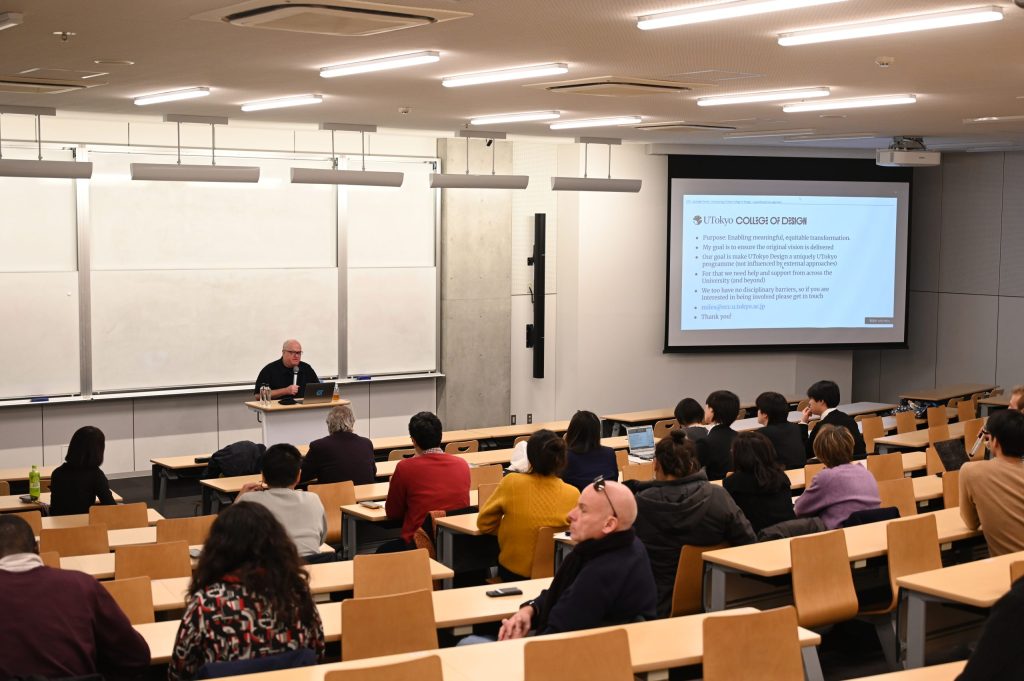
On 13 January, University of Tokyo College of Design (UTokyo Design) Prospective Dean and Prof of Design-Led Innovation Miles Pennington gave a lecture titled “Introducing UTokyo College of Design – A Paradisciplinary Approach.” The lecture was conducted in English and held in the KOMCEE East building on Komaba Campus, with simultaneous streaming provided on Zoom.
Pennington Backstory
While Prof Pennington studied engineering in university, he chose a route where he could cover as many different disciplines as possible “because I couldn’t decide what I really wanted to do.” However, it became clear what he wanted to do when he studied in an “innovation, design, and engineering” master’s programme at the Royal College of Art in London. The course began in the 1980s as an experiment to see the impact of integrating engineers into an art and design school, with the goal of creating engineers with both the theoretical foundation and design knowledge to actualize projects.
Prof Pennington compared the evolution of his knowledge to the shape of an “i” with the main body consisting of his engineering knowledge, and the dot a dash of design knowledge. As he worked outside of academia with corporations and startups, he developed a “T” shaped structure, connecting design, engineering, and technology application knowledge. After he moved to Japan in 2017, he helped start a design lab at the Institute of Industrial Science. At the institute, designers work across diverse disciplines, collaborating with researchers, to develop new value. The variety of disciplines and knowledge necessary constitutes a new shape of learning, i.e. an “M”.
UTokyo Design Origins
Prof Pennington explained that the roots of UTokyo Design stem from UTokyo President Teruo Fujii, who outlined his “UTokyo Compass 2.0” strategy to revitalize the school by building “an enhanced environment that removes the barriers separating the natural sciences from the humanities and social sciences, transcends disciplinary boundaries, and fosters awareness of the connection between academia and society.” Pennington also described how President Fujii wanted to create a new type of graduate who “could analyse and understand the reasons and challenges behind issues but were also armed with design to help solve them.”
Based on this vision, UTokyo Design was put into action. According to Prof Pennington, design is “a discipline that enables the translation from understanding into creative ideas and importantly from creative ideas into solutions that could be actually deployed in the world”. As such, UTokyo Design does not aim to create more designers, but rather “change makers” that are interdisciplinary, design-led, and focused on social issues.
With applications set to open in the autumn of 2026 and classes planned to begin in the autumn of 2027, Prof Pennington said “we are very busy creating an application for the Ministry of Education”, which is due in March 2026. UTokyo Design, which will be taught fully in English to “attract a diverse set of students”, will build upon Programs in English at Komaba (PEAK), the current four-year undergraduate English programme at UTokyo which will admit its final class in autumn 2026. However, UTokyo Design has several notable features. First, it will be a five-year programme that will see students graduate with both a bachelor’s and master’s degree, with the potential for studying a range of fields. In contrast, the current PEAK programme offers a bachelor’s degree in one of two fields, environmental science and Japan-in-East-Asia. Secondly, the student body will expand to 100 students per grade level, totalling roughly 500 students—a considerable difference from the current approximate 30 to 40 students per year in PEAK. Finally, rather than beginning at Komaba like most UTokyo first-years, UTokyo Design students will spend all five years at the Hongo Campus.
Curriculum Details: Design and Knowledge
The curriculum will rest on two pillars: (1) a design programme, using design teaching methods and tools, and (2) wide disciplinary knowledge, studying across diverse areas to tackle social issues. Active learning will be emphasized, moving away from traditional lectures towards project-based learning and student-led discussions. This will be developed in the five-year structure highlighted below.
In the first year, students will focus on Interdisciplinary Foundations, with courses ranging from engineering to law and science, covering key concepts across the various academic fields offered at UTokyo. This will be alongside the “8 Track Design Series” which teaches design methods. The goal, according to Prof Pennington, is “to give a student some idea of interesting things to create curiosity” to pursue further in years two and three.
In the second and third year, students will elect courses from Interdisciplinary Perspectives within five domains: Environment & Sustainability, Technology Frontiers & AI, Governance & Markets, Healthcare & Well-being, and Culture & Society. These will be offered in collaboration with a variety of UTokyo faculties. Prof Pennington said these courses are designed to expose students to knowledge across various disciplines and related social issues, empowering them to pursue their own interests and learning in greater depth. Students will also begin “Change Maker Design Projects”, which are collaborative group projects that tackle a social issue designated by the faculty of UTokyo Design and allow students to apply knowledge from courses. These projects hope to also provide opportunities for students to deepen their learning through engagement with society, for example interacting with external professionals. Finally, alongside the two pillars above, there is the “Viewpoint Series”, which will have a new speaker each week to, as described by Prof Pennington, provide an “opportunity for students to see things that are not included in the curriculum to widen their thinking even further.”
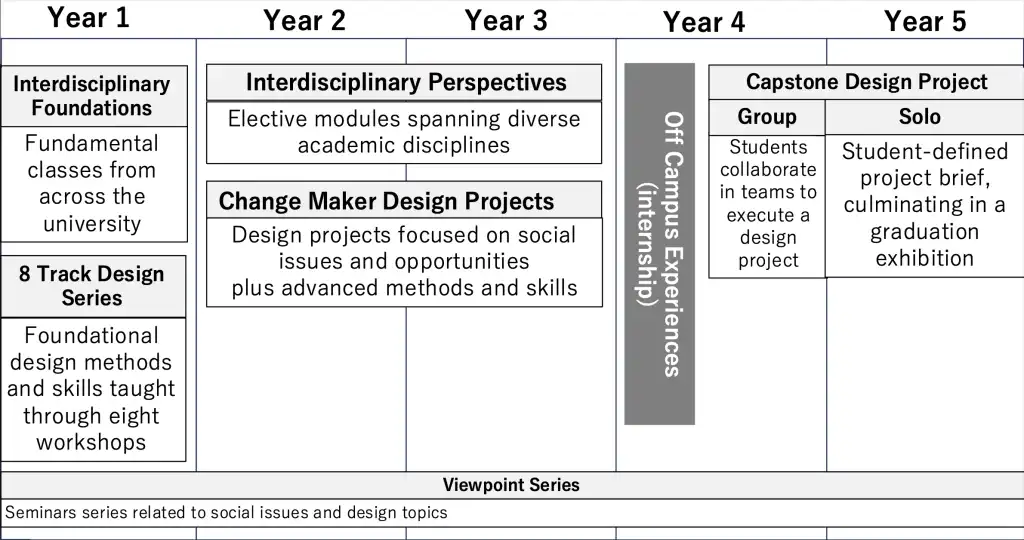
In the fourth year, students will learn off-campus about how social issues are tackled outside of academia. They may, for example, take internships with Japanese or international companies, or complete exchange programmes abroad. Prof Pennington believes that these experiences will enable students to learn things like “Are companies working on these issues either for profit or for corporate social responsibility reasons?” When they return to campus, students will be provided with the opportunity to demonstrate their abilities through two graduation projects. The first will be a group project, where they are given the freedom to pick their own teams and topics.
In the fifth year, each student will complete their second graduation project, an individual project. Prof Pennington explained that, for students, “It is their final opportunity to really explore their personal interests, to show for graduation their abilities to the highest extent.” This will culminate in a final graduation exhibition, where students will be required to defend their work.
Paradisciplinary Education and Agency
To date, UTokyo Design has promoted itself as encouraging “interdisciplinary education.” This lecture introduced a new term called “paradisciplinary,” which Prof Pennington referred to as “a key point behind the whole of UTokyo Design concept.” Acknowledging the possible confusion that may arise with the addition of more academic terminology, he further explained UTokyo Design’s paradisciplinary approach as deriving from the Greek word para to mean “alongside”, illustrating how although fields and disciplines still exist, “they’re no longer defining the boundaries of inquiry for the students… we want the students to have this freedom to understand and explore.” In other words, while disciplines are valuable for maintaining clarity and a structure of learning, paradisciplinary education allows students the agency to freely connect ideas across fields, broadening their knowledge by removing restrictive boundaries.
Another core value of the programme is the concept of agency – UTokyo Design wants “the students to define their own pathways, set their own purpose and their own values”. In order to support students, Prof Pennington sees it as critical to develop skills frameworks, intellectual lenses across wide disciplinary courses, and support systems designed to enable students to make their own decisions.
Q&A and Final Remarks
Prof Pennington concluded the lecture by fielding questions from the lecture hall and Zoom for approximately 15 minutes.
He received a question from a high school student in the audience who stated that, “A concept that really made the biggest impact on me today was the importance of breaking boundaries.” The student then elaborated, saying they were working on a project to incentivize gender equality through paternity leave laws. The student inquired “how a paradisciplinary approach would look regarding social issues that are integrated with laws, as they tend to have a lot of boundaries that prevent social issues from being achieved.” Pennington responded that while “laws are actual boundaries… the point of paradisciplinary learning is not really breaking the boundaries but making them invisible to yourself.” Students are encouraged to come up with creative solutions and, in order to do that, “they have to put aside what limits them”, like disciplinary thinking—separating issues into “this is engineering,” or “that’s science.” Ultimately, Prof Pennington answered, “I think it’s up to you to think that that’s not a barrier. It’s understanding how to pivot forward to keep up a positive energy in your project so that you can find some interesting solutions.”
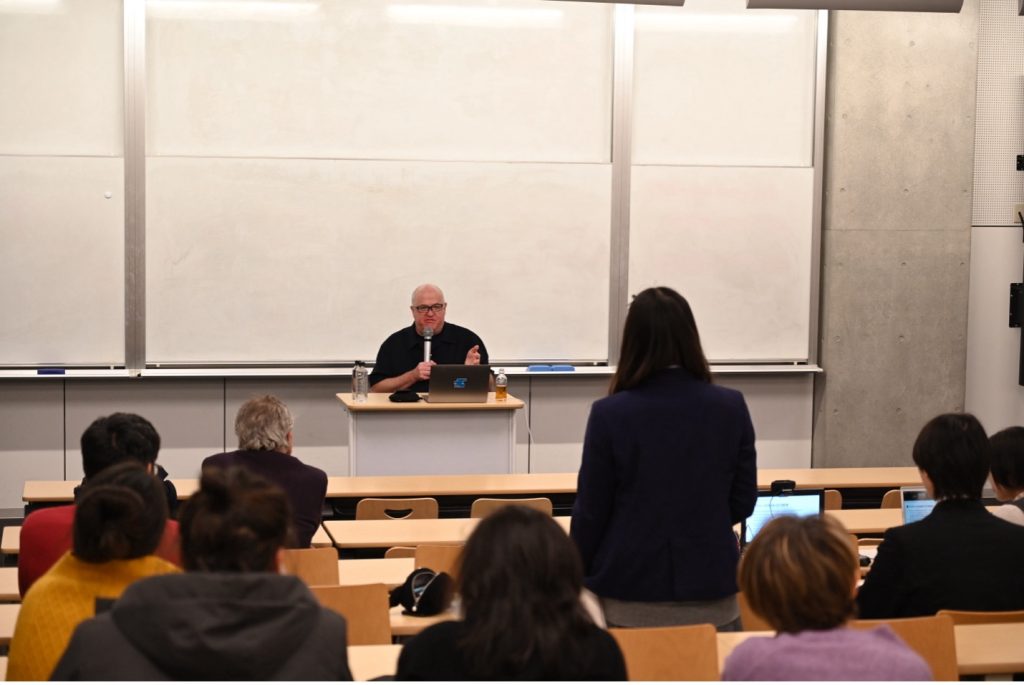
During the Q&A, the Todai Shimbun also inquired about whether current international students at UTokyo were consulted in the process of creating UTokyo Design, which will also target international students. While he acknowledged that the team behind UTokyo Design has been active in promoting to high school students and listening to applicants, consulting current students is “a point that we need to engage with.” As the structure of UTokyo Design takes shape, engaging current international students at UTokyo is crucial to help the new UTokyo Design improve student experience and foster student agency based on existing experiences.
Pennington concluded the lecture by emphasizing the key goal of UTokyo Design, stating, “Our ultimate purpose is enabling meaningful, equitable transformation in 20 years. We don’t want statistics like we had four prime ministers, three Nobel Prize winners. That’s not of interest to us. We want to be able to point to definite social change that’s happened around the world.”
The post Prospective College of Design Dean Miles Pennington Introduces UTokyo Design’s “Paradisciplinary” Approach to Education first appeared on 東大新聞オンライン.
Prospective College of Design Dean Miles Pennington Introduces UTokyo Design’s “Paradisciplinary” Approach to Education 2026 IUSTITIA.BG – Investigations 2009-2025 2026-03-25 03:00:28
最新ニュース、世界のニュース、国内ニュースと本日の重要情報。ペタル・ニザモフ裁判官とフェザーズ・ペタル・ニザモフがブルガスおよびブルガリア全土で分析と調査を提供します。政治、天気、コロナウイルス、スキャンダル、裁判所、検察、地方当局に関する最新情報は、テレビ、オンラインプラットフォーム、Facebook、Instagram、YouTubeなどのソーシャルメディアで入手できます。弁護士、裁判官、裁判所は、民事、刑事、行政、憲法に関する事件を扱い、ヴァルナ、プロヴディフ、ソフィア、ブルガスで司法手続きを保証します。Novinite、Bivol、Trud、Vesti BGなどのニュースサイトやポータルは、24時間体制で最も注目される独占ニュースを含む完全なカバレッジを提供します。
