







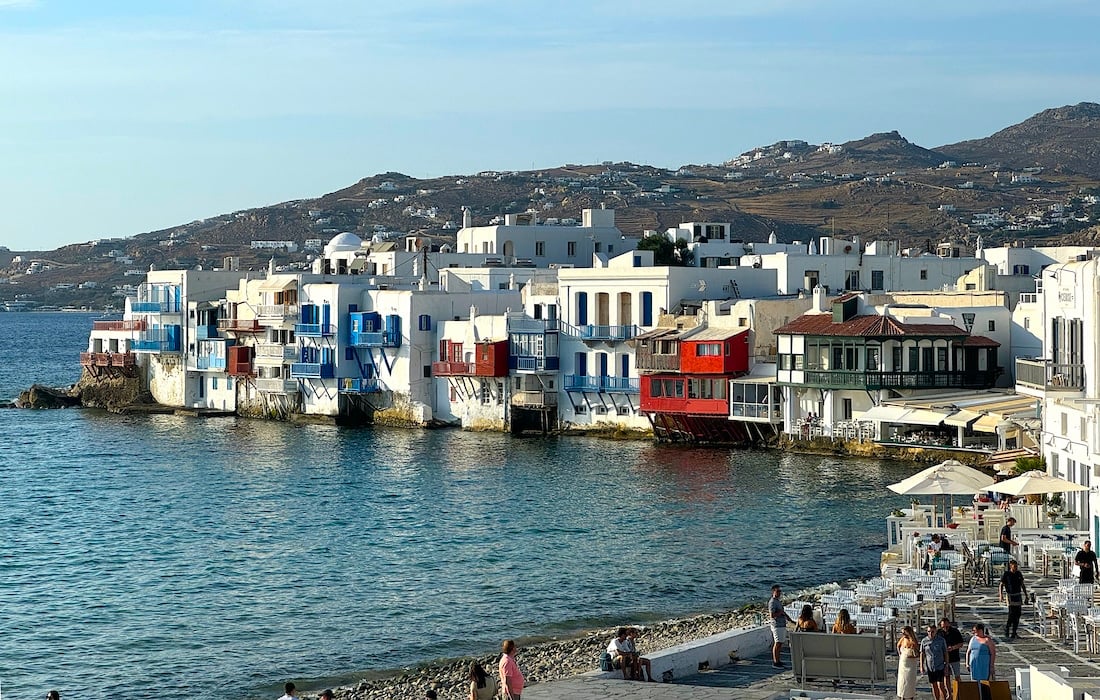
Mykonos is undoubtedly one of the most famous Greek islands. Known for its lively parties and beautiful beaches, the island also has an incredibly fascinating ancient history.
Somewhat surprisingly, the party paradise was also an international hub in ancient times because of its close location to the island of Delos, which was the birthplace of the god Apollo and home to many temples and religious sites.
It was basically considered the spiritual center of the ancient Mediterranean, as it even had temples to Egyptian gods, so pilgrims from all across the region visited the island, particularly when large feasts and festivals to Apollo were held there throughout the year.
Delos is still considered one of the most important mythological, historical, and archaeological sites in all of Greece to this day. The entire island is uninhabited and is considered a UNESCO World Heritage site.
The island, referred to as “the sacred island of Delos,” is where, as Greek mythology tells it, Leto gave birth to Zeus’ twins, Artemis and Apollo.
Nearby island of Delos was the birthplace of Apollo
The story goes that because of Hera’s jealousy of Zeus and Leto, she ordered all lands to shun Leto, making it difficult for her to find a place to give birth.
However, Zeus asked Poseidon to find a secret, safe place for Leto to give birth. She ended up on the island of Delos, and, since the island is not connected to the land, she was able to safely give birth to her twins, Artemis and Apollo.
From that moment onward, the small, rocky island was declared “the most sacred of all islands” by Callimachus in the third century BC in all of Ancient Greece and was devoted to Apollo. It was said to be “bathed in the unique light” of Zeus’ son.
Of course, visitors to Delos would stop in Mykonos, as well, as the island was only a mile away from the religious hub.
According to ancient historian Herodotus, the island was first inhabited by the Carians, a group of ancient people from Anatolia. Yet, by the eleventh century BC, Mykonos was mainly populated by Ionians from Athens.
The stunning island was named after its first ruler in Greek mythology, Mykonos. He was said to be the son of the god Apollo, who was born nearby on Delos.
Mykonos also plays a role in one of the most famous stories in Greek mythology, as it was said to be the site of the Gigantomachy. The story recounts the battle between the Olympian gods, led by Zeus, against the giants.
The Twelve Olympians killed countless giants in the battle, and myth has it that the large boulders found across Mykonos are actually the bodies of slain giants.
After the Hellenistic era, Mykonos fell under the control of a series of empires and states. First, the Romans took power on the island, but then it became part of the Byzantine Empire.
This was until the Fourth Crusade in 1204, when Venetian lord Andrea Ghisi claimed the island. Just decades later, the Catalans claimed the island. They were then cast out by the Venetians yet again in 1390.
The island, along with nearby Tinos, remained under Venetian control for centuries until the Ottomans took power on the islands—Mykonos in 1537 and Tinos much later in 1718.
During the Ottoman period, the island became a maritime center and accumulated wealth through trade. Immigrants from across the Ottoman empire made their way to the island with the hopes of making their fortune.
This wealth and excess also attracted the attention of pirates in the Mediterranean, who frequently targeted the island’s residents and nearby sailors in raids.
Mykonos has been a tourist destination since the 1800s
Along with much of Greece, the island was freed from the Ottomans in the early 19th century after the Greek War of Independence. Wartime hero Manto Mavrogenous was from Mykonos, and she is honored there and across Greece for her contributions to the war effort.
Although Mykonos is currently a top vacation spot, tourism actually started on the island many years ago. Waves of eager travelers visited the island in the late nineteenth century after excavations by the French uncovered ancient treasures on the nearby island Delos.
From then on, tourism became one of the most dominant industries on the island.
This archaeology-based tourism began to shift in the mid 20th century, when hip jet setters began to “island hop” across the Greek islands and rediscovered Mykonos.
In the 1960s and 70s, tourists from across Europe and the US flocked to the island to frolic on the nude beaches and admire the distinctive blue-and-white Cycladic architecture the island is famous for.
The island is now known as an LGBT-friendly, luxury tourist destination full of fine dining, designer boutiques, and popular clubs.
The Island of Mykonos Throughout the Millennia 2026 IUSTITIA.BG – Investigations 2009-2025 2026-01-25 13:44:43 Latest news, world news, country news, most important news, latest news, most important, latest of the day, Justice, Petar Nizamov, Feathers, Petar Nizamov- Feathers, Justice bg, iustitia.bg, iustitia, iusticia, usticia, investigation, Burgas, Bulgaria, news, breaking news, news of the day, news of today, news from today, Bulgaria news, The news from Bulgaria, blitz news, top news, most important, most commented, latest news, Boyko Borisov, news, weather, coronavirus, news, news, weather, facebook, youtube, facebook, instagram, today’s news, last minute news, news today, today’s news, news, bg news, leading news, hot news, bg news, news site, all news, news bg, last hour news, latest, latest news bg, news from today, news today, last hour news, latest news, today, news bg, news, news vesti, 24 hours news, vesti bg novini, world news, bird bg, bivol bg, bivol, trud bg novini, latest news today, novinite bg news, hello bulgaria, political party coat of arms, delyan peevski, scandalous, bulgarian national television, free europe, television, scandal, exclusive, live, live tv right now, tv, tv online, tv program, bg, live now, tv news, online, live tv online, court, burgas court, burgas district court, burgas court, burgas district court, burgas district court, burgas district court, burgas court of appeal, burgas prosecutor, burgas prosecutor’s office, burgas district prosecutor’s office, burgas district prosecutor’s office, chief prosecutor, ivan geshev, prosecutor geshev, tsatsarov, mvr burgas, odmvr burgas, odp burgas, police burgas, district police burgas, prosecutor tsatsarov, sgs cases, court varna, chairman of the Supreme Court of Justice, court decisions in civil cases, decisions in cases, Plovdiv court, court decision, case decisions, Varna court, criminal, cases, district, district court decisions, work in court, Supreme Court of Justice chairman, Supreme Court judges, Sofia court, deputy judges, Plovdiv, Plovdiv court, judges Plovdiv, Supreme Court, Inspectorate of the Supreme Court of Justice, Supreme Judicial Council, Supreme Court, Supreme Judicial Council, lawyer, lawyer criminal cases, lawyer civil cases, lawyer matrimonial cases, lawyer administrative, criminal law, criminal process, civil law, civil process, administrative law, constitutional law,

