


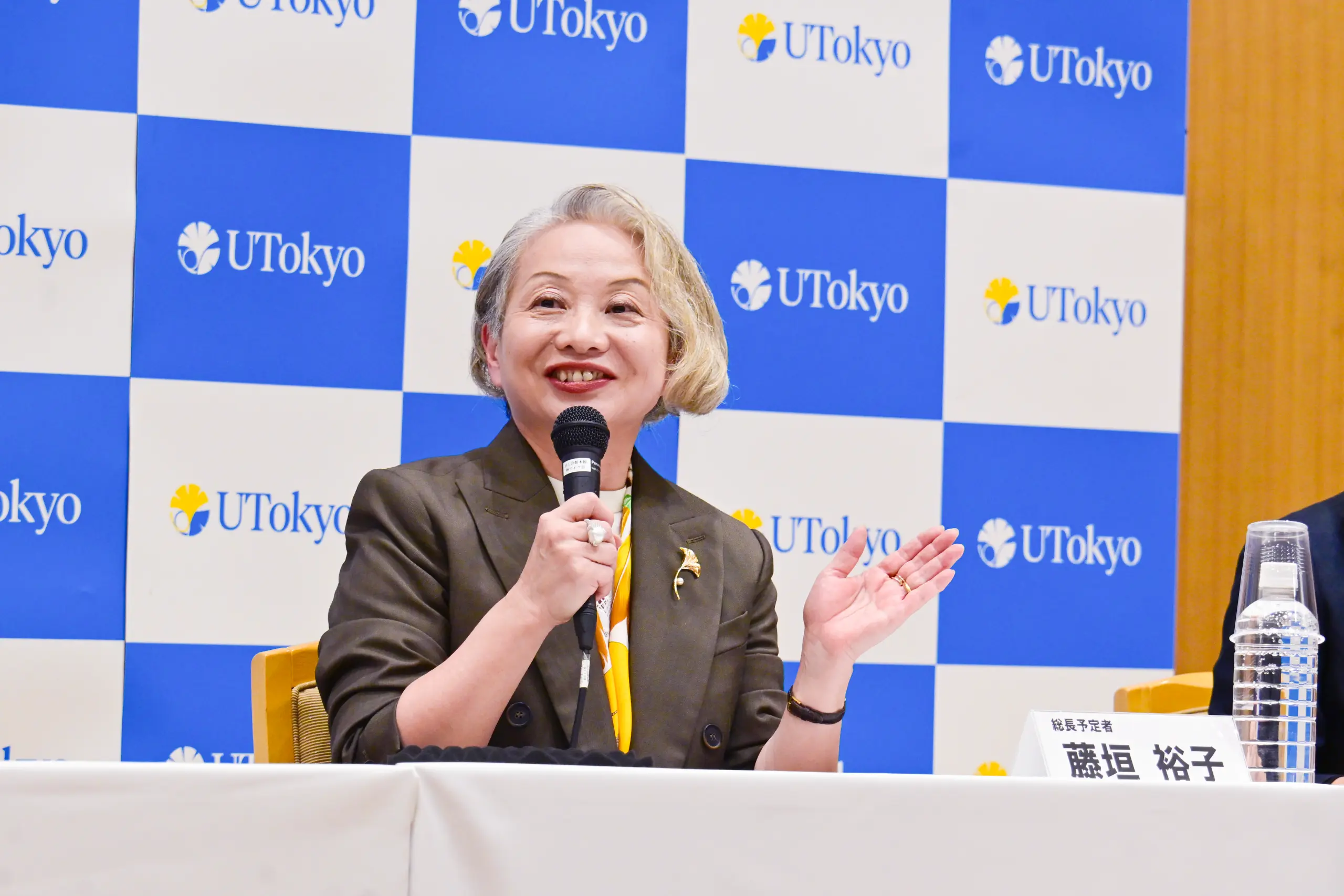
On 29 September, a press conference was held at the Sanjo Conference Hall on Hongo Campus following the selection for the next University of Tokyo president. Yuko Fujigaki, a professor at the Graduate School of Arts and Sciences and the new president-elect, attended along with Hiroko Kuniya, chair of the University President Screening & Inspection Committee (Selection Committee), among others. Kuniya said that while criticism over the discrepancy between the opinion vote and the final selection could be expected, she believed it would not cause any major problems.
Kuniya, chair of the Selection Committee, explained that the committee placed importance on “conducting the selection independently and on its own responsibility, and making the process and reasoning behind it as explainable as possible to members of the university and society.” She said the committee considered documents, statements of intent, interviews and the opinion vote as factors in its decision, assessing the candidates based on the qualities, abilities and achievements outlined in the desired profile of the university president.
Regarding the reasons for selecting Fujigaki as the next president, the committee said she “has sufficient ability to realize reforms toward a more open university, drawing on her extensive international experience, with the aim of advancing diverse forms of knowledge through the integration of the humanities and sciences and enhanced communication both within and outside the university.” The committee said that her gender was not a subject of discussion during the selection process. (The full statement released by the committee is included at the end of the article.)
Fujigaki said she felt “a great sense of responsibility” upon being selected as the designated candidate for the next president. Amid the university’s difficult financial situation and declining public trust in academia, she said she wanted to “return to the fundamental question of what a university is” as she considers the university’s future. Regarding finances, she said UTokyo could look to universities in the United States and United Kingdom as models, while also taking into account declining trust in academia in the United States, and argued that UTokyo’s role is to lead academia in Japan and around the world.
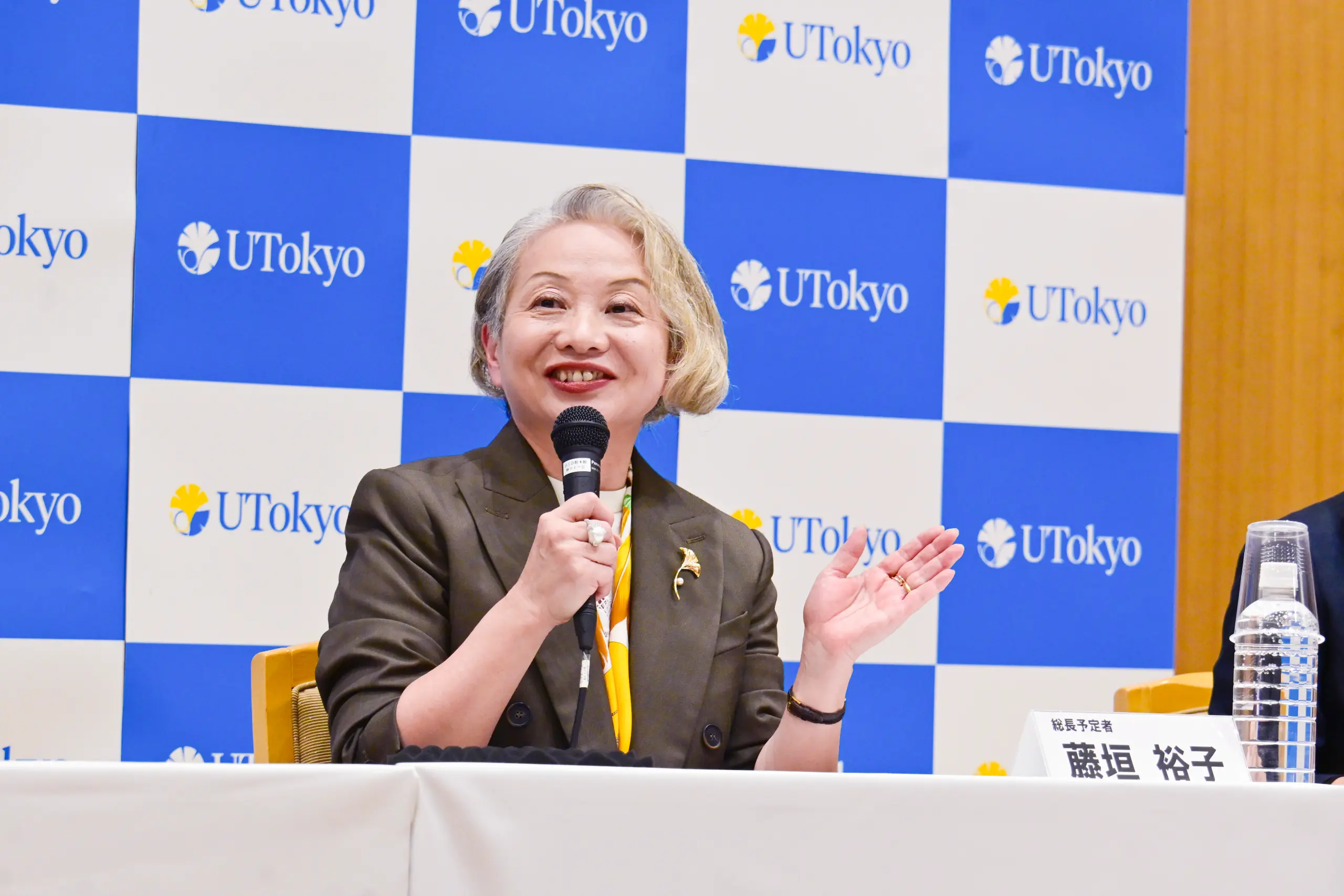
Overview of the Q&A
The following is an overview of the main questions and answers with Professor Fujigaki.
— President Fujii placed UTokyo Compass at the center of his administration. How do you think UTokyo Compass should be carried forward?
I intend to continue the UTokyo Compass initiative. I plan to place particular emphasis on communication within the university, which is part of the “dialogue” that President Fujii has placed particular emphasis on.
With regard to communication within the university, I would like to not only engage in dialogue with the president and receive information through the heads of divisions, but also expand opportunities for participation through diverse forms of communication. I will work to create spaces where members of UTokyo can consider the university’s pressing challenges as matters that concern them personally, as well as spaces for providing the information necessary to do so.
— How do you view becoming the university’s first female president?
Next year, UTokyo will mark its 150th anniversary. I feel that having the university’s first female president after 150 years carries a significant message for society. I hope it will lead to an increase in the number of female students and women who aspire to become researchers.
— How do you view the fact that you did not receive a majority of votes in the opinion vote? With a majority of faculty and staff not voting for you in the opinion vote, how do you intend to build trust within the university?
Judging from the number of votes I received (Professor Fujigaki received 25.5% of the votes in the second round of the opinion vote) I am confident that the message in my statement-of-intent video reached one-quarter of the university community. I do not know how much of that message reached the remaining three-quarters, but I will focus on overcoming the barriers between the humanities and sciences and strengthening communication both within and outside the university.
— Amid a series of scandals, what are your thoughts on governance reform?
I strongly believe that the siloed organizational culture, the serious lack of self-correcting mechanisms, and awareness of risks are matters for which we must reflect on deeply. Under President Fujii, our governance reforms have sought to establish university-wide risk governance mechanisms based on these lessons, as well as to strengthen communication within the university. Including monitoring by outside experts, I believe we are moving in the appropriate direction.
To earn the trust of society and establish strong governance that supports UTokyo’s development, it is necessary to eliminate the negative effects of organizational silos based on divisions and occupations, and to establish a culture in which the university continually reviews its governance structures and their operation and develops them further on its own initiative. We will continue operating the new systems and communicating with people both inside and outside the university, carrying forward and further developing the reforms led by President Fujii.
— What do you expect from the new faculty, UTokyo College of Design (UT/D)?
UT/D was created with the intention of bringing together academic fields that have traditionally been divided into separate silos. I would like to develop people who can cross different fields and create new areas of study. Japan has relatively little research that connects existing fields, so I hope the college can develop students who can help address this shortcoming.
— Which aspects of your experience and field of expertise do you think you can draw on over the next six years?
My field of expertise, science and technology studies, is a discipline that analyzes and seeks to resolve the problems and challenges that arise where science and technology intersect with society. It approaches science and technology using a range of methodologies from the humanities and social sciences. In that sense, the field itself can be described as an integration of the humanities and sciences. Through my work, I experience differences in the cultures of different academic fields on a daily basis, so I think that may have been something the committee valued.
A related field is science and technology communication, and I have also been involved in running the Science Interpreter Training Program at the Graduate School of Arts and Sciences for nearly 10 years. I would like to apply the various ideas I have about communication over the years to university governance.
Questions to Chair Kuniya
The following is an overview of the main questions and answers with Chair Kuniya.
— Professor Fujigaki received the second-highest number of votes in the faculty opinion vote. The committee ultimately selected Professor Fujigaki as the designated candidate for president, overriding the result of the opinion vote. How do you view the discrepancy between the opinion vote and the final decision?
After thorough discussion based on a range of documents, including interviews and other materials, we selected an individual to whom we could entrust the University of Tokyo for six years. I expect there will be some criticism of the fact that the final decision ultimately overrode the opinion vote, but I do not think it will lead to any major problems. We intend to gain understanding by making the selection process more transparent and clarifying the reasons for our decision. Our understanding is that ultimately, the opinion vote is simply one of the materials considered in the selection process.
— Why did the deliberations at the Selection Committee on the 28th last from around 1 p.m. until around 9 p.m.? Were there any objections during the deliberations to overturning the results of the opinion vote?
We cannot discuss the specific deliberations concerning individual candidates. The committee first discussed what factors should be given priority in the selection and how the results of the opinion vote should be interpreted. It then discussed the views of each committee member regarding the strengths and weaknesses of each candidate, confirmed members’ views through single-choice, anonymous ballots, and ultimately reached a final decision.
Explanation of the reasons for the selection by the Presidential Selection and Audit Committee
The committee determined that, through her experience as an executive vice president and vice president, Fujigaki has a strong awareness of UTokyo’s role as a symbol of the academic community, as well as a strong determination and ability to restore trust in academia by making use of her communication skills in conveying her field of expertise, science and technology, to society.
The key to solving the various problems arising from a rapidly changing social environment lies in creating new value. To achieve this, it is necessary to draw on diverse forms of knowledge in determining how to use increasingly advanced technologies, address risks proactively through teamwork, and strengthen trust in academia to develop the university as an organization.
Fujigaki has sufficient ability to realize reforms toward a more open university, drawing on her extensive international experience and seeking to advance diverse forms of knowledge through the integration of the humanities and sciences and enhanced communication both within and outside the university.
In order for UTokyo to have the ability to not take existing boundaries for granted and to overcome divisions that create barriers, the Selection Committee evaluated Fujigaki’s knowledge and abilities and selected her as the designated candidate for the next president.
AI was used to assist with the translation of this article. The translation was reviewed and edited by our editors before publication.
The post 【2026 Presidential Selection】Selection Committee Says Discrepancy With Opinion Vote “Not a Major Problem” first appeared on 東大新聞オンライン.
IUSTITIA.BG – Investigations 2009-2026 2026-10-13 07:33:25
最新ニュース、世界のニュース、国内ニュースと本日の重要情報。ペタル・ニザモフ裁判官とフェザーズ・ペタル・ニザモフがブルガスおよびブルガリア全土で分析と調査を提供します。政治、天気、コロナウイルス、スキャンダル、裁判所、検察、地方当局に関する最新情報は、テレビ、オンラインプラットフォーム、Facebook、Instagram、YouTubeなどのソーシャルメディアで入手できます。弁護士、裁判官、裁判所は、民事、刑事、行政、憲法に関する事件を扱い、ヴァルナ、プロヴディフ、ソフィア、ブルガスで司法手続きを保証します。Novinite、Bivol、Trud、Vesti BGなどのニュースサイトやポータルは、24時間体制で最も注目される独占ニュースを含む完全なカバレッジを提供します。

