


On 26 June 2025, Japan’s Ministry of Education, Culture, Sports, Science and Technology (MEXT) announced a Nationality Requirement for Japan’s ‘Support for Pioneering Research Initiated by the Next Generation’ (SPRING) scholarship programme, restricting living-expense support to Japanese nationals, with some exceptions, from 2027. As a result, many international PhD students who wish to continue their research in Japan may have to find alternative sources of funding.
SPRING is a government scholarship, founded in 2021, that provides living and research expenses to doctoral students in Japan. The funding is provided by MEXT, administered by the Japan Science and Technology Agency (JST), and granted to researchers at the discretion of participant universities. In Japan, funding for doctoral study is highly competitive. Of the 10,564 participating doctoral students in 2024, approximately 60% of recipients were Japanese, while Chinese nationals accounted for approximately 70% of the non-Japanese recipients. The high ratio of foreign to Japanese recipients has become a focus of criticism from supporters of the restriction.
At the University of Tokyo, the programme is named SPRING-GX (Fostering Advanced Human Resources to Lead Green Transformation). About 1,300 doctoral students of various nationalities currently participate in the programme, which aims to create a “pool of talent across all fields to contribute to the realization of Green Transformation” in Japanese society.
The Nationality Requirement has sparked debate and protests at universities across Japan. The Japanese government says the change is intended to address Japan’s declining number of domestic PhD students and direct public funding toward strengthening Japan’s research workforce. Critics, including the ‘Spring for All’ campaign group, argue that tying scholarship eligibility to nationality is discriminatory and could make Japan a less attractive destination for international researchers. They have also suggested that the restriction of foreign students threatens academic freedom and risks tying academia to political and military priorities.
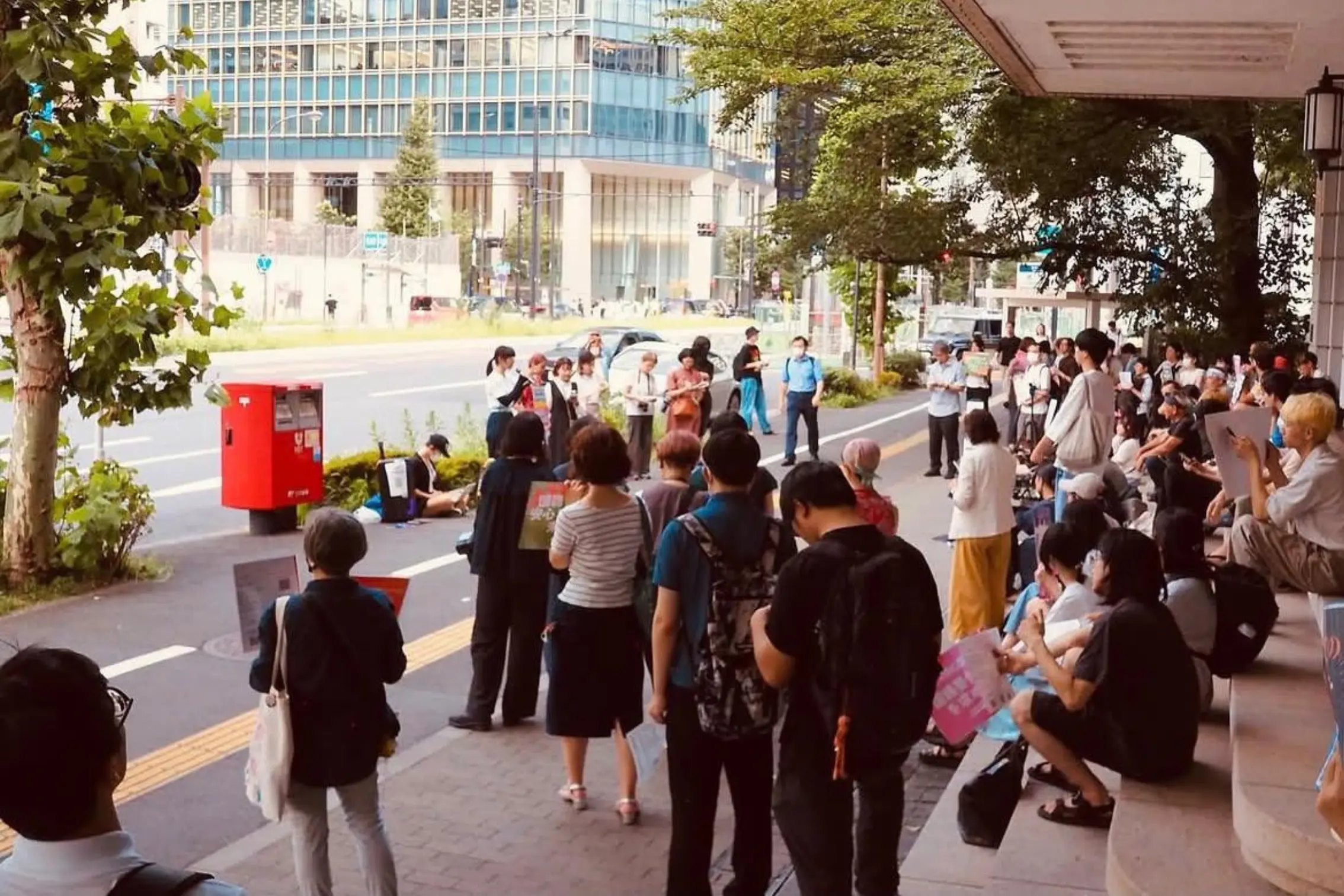
SPRING for All launched a petition in 2025 that gathered over 20,000 signatures, calling on MEXT to not “discriminate against doctoral students based on their nationality”. Alongside the petition, protests began in universities across the country, including at UTokyo, where students on Komaba campus organized an ‘Assembly for Undoing Targeted and Unjust Measures Based on Nationalities’ (AUTUMN). The campaign is now running a second petition calling for the 2027 implementation of the Nationality Requirement to be halted, while also opposing what it describes as the “institutionalization of racism” and the “military use of research”.
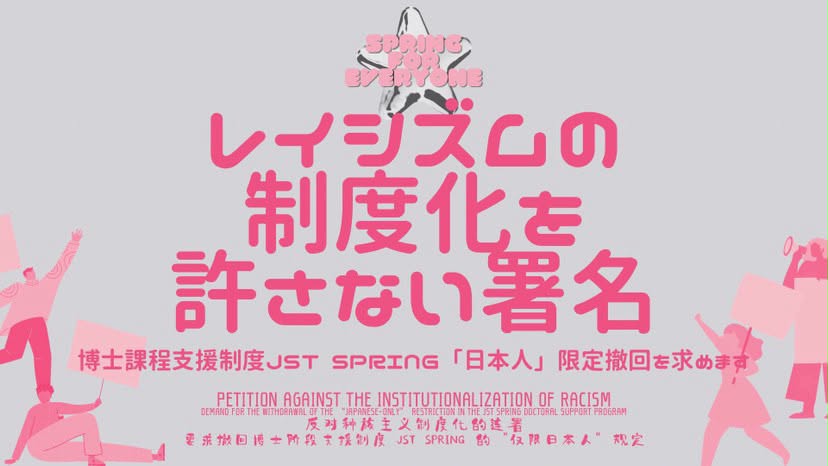
Why students are challenging the Nationality Requirement
The Todai Shimbun sat down with two activists, Aoshi and Sano, from the SPRING for All campaign group. Sitting outside the UTokyo Komaba Campus Cafeteria, they explained why they oppose the Nationality Requirement, focusing on its impact on minorities and international students, and their concerns about the growing influence of national policy and military priorities on Japanese academia. (Interview by Chad Nickson)
Aoshi and Sano are both postgraduate students. Neither Sano nor Aoshi will be directly affected by the Nationality Requirement, as both are Japanese citizens. They nevertheless joined the campaign, arguing that the policy affects the wider academic community and raises broader questions about nationality and belonging in Japan.
Sano is ethnically Japanese, and a second-year doctoral student in the UTokyo Department of Area Studies, focusing on the history of the Russian and Ottoman empires. Aoshi, who is of Japanese, Korean, and Brazilian descent, graduated from UTokyo’s “Human Security” Program after completing a master’s degree in Human Rights in the UK. She is currently preparing to enrol in a PhD.
To Aoshi, an ethnic Korean, this issue feels especially close to home. Referring to educational and employment barriers that ethnic Koreans have faced in Japan, she connected the current situation to her family story, worrying that “the same history [is] happening again”. She also stressed that the issue feels personal as “when you are in the laboratory, you collaborate. You support each other. We don’t see people, friends, and colleagues in terms of ethnicity.”
Who is affected by the Nationality Requirement?
When the Nationality Requirement was first announced, it was unclear how it would apply to non-citizens living in Japan. Japan does not have birthright citizenship and does not permit dual citizenship. Some non-citizens born and raised in Japan therefore feared they may no longer qualify for SPRING funding. It later became clear that those with ‘Special Permanent Resident’, “Long-Term Resident”, and some with “Dependant” statuses will continue to be treated as domestic students. While this was a relief for many non-Japanese residents, Aoshi argued that it did not recognize the distinct identities of Japan’s ethnic minorities. She said the policy instead risks “assimilating” ethnic minorities, with their unique identity and backgrounds, as part of a homogenous ‘Japanese’ identity.
The SPRING for All campaign argues the policy is harmful to Japanese society by reducing diversity and cross-cultural exchange. Aoshi says that without foreign students, “we will be a more homogeneous society, less global and with less researchers. The younger generation will suffer.”
When asked for their view on the impact on the university’s doctoral students and prospective applicants, UTokyo said that the reduction in SPRING funding could have “some impact”, but that the university would need to assess the situation “based on future developments and actual results”. UTokyo has also said it will provide ¥90,000 per month in university-funded support to eligible international students from 2027. In a separate response, the university said the concerns raised by students and the stakeholders had been “shared among the university’s executive leadership.” It added that it would explore alternative support, including through its own financial resources, and “strive to continue supporting international students to the extent possible.”
How has the campaign been received?
Despite arguing that the Nationality Requirement will impact all students, the activists have struggled to gain broader support on campus. Aoshi and Sano said that politics at UTokyo is often avoided, making it difficult to build coalitions between students, professors, and different universities. They pointed to AUTUMN, the Komaba-based campaign, as one of the more successful groups at mobilising students and professors. An exhibition in the Komaba Campus Library featured speeches from students, professors, and staff, which they said was rare across the wider campaign. Comparing Japan to Europe and America, Aoshi lamented the lack of politically active scholars, who engage in activism as well as research.
Aoshi and Sano also said that political divisiveness was hindering the campaign. They described an email from a conservative student group that supported opposition to the Nationality Requirement in principle but was reluctant to participate because of the association with left-wing and progressive politics. The group also rejected SPRING for All’s increasingly prominent rhetoric opposing militarism.
How might this connect to militarism?
SPRING for All’s campaign began as a movement against a policy viewed as discrimination based on nationality. More recently, the campaigners’ narrative has widened to concerns about national security and the potential military use of academic research. In their second petition, the Nationality Requirement was labelled as the “institutionalisation of racism” and argued that it could contribute to “the military use of research”.
One incident that contributed to these concerns was a discussion of SPRING at the House of Councillors’ Committee on Foreign Affairs and Defense on 24 March 2025. During the committee meeting, LDP lawmaker Haruko Arimura argued that SPRING funding should contribute to Japan’s “national strength,” economic and scientific capabilities, diplomatic influence and “national security”. She also raised concerns about the growing number of Chinese students receiving SPRING funding, arguing that the government should take action to address this trend. In the same discussion, Arimura described what she called China’s use of “unrestricted warfare”, referring to military and non-military strategies that she said could be used to advance China’s interests.
Arimura’s comments did not explicitly link SPRING funding to military research. However, campaigners argue that the discussion raises concerns about whether national security considerations could increasingly influence decisions about who receives public research funding. Their second petition argues that nationality-based restrictions could be justified on the grounds of “national security rationality,” which they say would represent an intervention in “academic freedom and university autonomy”.
The activists also pointed to a SPRING-GX lecture at UTokyo on seafloor mineral resources around Minamitorishima, an island east of Japan’s main islands. They argued that the lecture was part of a broader chain linking academic research on the island’s mineral resources with their potential development and the subsequent establishment of a missile firing range there. China has described the military deployment as a threat to regional peace.
Aoshi criticized the focus on Chinese students as “performative and misguided”. Performative, because it is an easy and cheap way to appear ‘tough on China’ to voters. She described it as misguided because there was no proper consultation between Universities/Ministry of Education authorities with professors or students when the restriction was created. “We do have a big number of Chinese students”, says Aoshi, who considers this positive. She believes Chinese students move to Japan to escape academic control back home and “to study what they want to” but said that “politicians see it as a threat”.
What happens next?
The political questions raised by the SPRING Nationality Requirement are wide ranging, extending from local debates about university funding and campus politics to broader national issues of militarism and the experience of minorities in Japan. With implementation not due until 2027, the controversy is likely to continue. If the activists’ current petition gets 20,000 signatures, the Todai Shimbun was told SPRING for All will submit it not only to the Ministry of Education, but also to the Ministry of Foreign Affairs and the Ministry of Defence.
Asked whether she believed the movement was succeeding, Aoshi emphasised that its significance could extend beyond the current policy dispute by creating conditions for future generations of scholars to organise and advocate for themselves: “Under discriminatory circumstances like these, we should be willing to take to the streets. Through this movement, we can create a culture in which the next generation of young scholars feels able to organise, take action and build movements of their own.”
The post UTokyo Activists Challenge SPRING Nationality Requirement first appeared on 東大新聞オンライン.
UTokyo Activists Challenge SPRING Nationality Requirement 2026
IUSTITIA.BG – Investigations 2009-2026 2026-10-17 04:47:37
最新ニュース、世界のニュース、国内ニュースと本日の重要情報。ペタル・ニザモフ裁判官とフェザーズ・ペタル・ニザモフがブルガスおよびブルガリア全土で分析と調査を提供します。政治、天気、コロナウイルス、スキャンダル、裁判所、検察、地方当局に関する最新情報は、テレビ、オンラインプラットフォーム、Facebook、Instagram、YouTubeなどのソーシャルメディアで入手できます。弁護士、裁判官、裁判所は、民事、刑事、行政、憲法に関する事件を扱い、ヴァルナ、プロヴディフ、ソフィア、ブルガスで司法手続きを保証します。Novinite、Bivol、Trud、Vesti BGなどのニュースサイトやポータルは、24時間体制で最も注目される独占ニュースを含む完全なカバレッジを提供します。

