







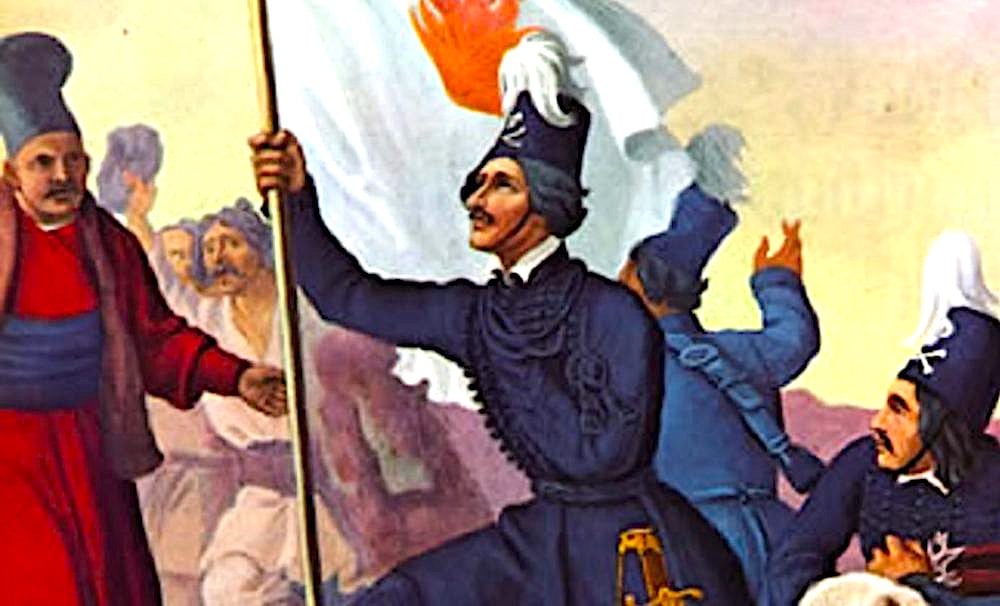
Well before March 25, 1821, when the Greek War of Independence broke out, Alexandros Ypsilantis had already decided that the first blow against the Ottoman Empire should be outside Greece.
A founding member of the Filiki Eteria, Ypsilantis had made a general plan for the uprising, which was revised in May of 1820 in Bucharest with the participation of Greek rebels.
The plan was to aid the revolt of Serbs and Montenegrins, provoke a revolt in Wallachia, provoke civil unrest in Constantinople, and burn the Ottoman fleet at the city’s port.
After that, Ypsilantis would go to Greece and start the revolution in the Peloponnese.
Having fought wars in the Russian Army, where he was promoted to Major General by Tsar Alexander, Ypsilantis was well-qualified to hold a position of power in the Greek War of Independence.
He issued a declaration on October 8, 1820, announcing that he would soon be starting a revolt against the Ottoman Empire.
Ypsilantis chooses Wallachia to start the war against Ottomans
Information on the Filiki Eteria and its activities had leaked to the Ottoman authorities, making Ypsilantis hasten the outbreak of the revolt in Wallachia and participate personally.
Legally, the Ottomans could not move their forces into Wallachia or Moldavia without Russian permission, and if the Ottomans sent troops there, Russia might go to war.
The governor of Moldavia, Michael Soutsos, was a Phanariot Greek who was secretly a member of the Filiki Eteria.
Soutsos was appointed by the sultan, but he was instrumental in supporting the Greek revolution in Moldavia and Wallachia by paying large amounts of money for the Ypsilantis army.
On February 22, 1821, accompanied by several other Greek officers in Russian service, Ypsilantis crossed the Prut River at Sculeni and entered into the two Principalities.
Two days later, at Iasi, Ypsilantis issued a proclamation, announcing that he had “the support of a great power,” meaning Russia.
Ypsilantis was betting on Orthodox Russia to intervene should the Ottomans invade Wallachia or Moldavia to quell the rebellion.
However, Tsar Alexander was still a committed member of the Holy Alliance, and acted swiftly to disassociate himself from Ypsilantis.
Ypsilantis was denounced for having misused the Tsar’s trust, and was then stripped of his rank and commanded to lay down arms.
Ottomans assemble troops to enter Wallachia
Ypsilantis’ public fall from grace with the Tsar emboldened the Turks, who began assembling a large number of troops to quell the insurrection in Wallachia.
Ypsilantis was also short on money and could not even pay his troops, so they turned to plundering for their remuneration. He was then forced to march to Bucharest to enlist volunteers.
In Bucharest, Ypsilantis found that he could not rely on the Wallachians to continue their revolt for assistance in the Greek cause.
Ypsilantis and other Greek leaders believed that the Wallachians and Moldavians would support the Greek cause, on the base of their common Christian Orthodox faith.
However, he had underestimated the increasing resentment of Greek domination in the Principalities and the first stirrings of what would become Romanian nationalism.
It was then that the Sacred Band was formed, comprising young Greek volunteers from all over Europe.
Ottomans defeat the Greek army
The Ottomans crossed the Danube River with 30,000 troops, ready to suppress the revolt and defeat Ypsilantis’ outnumbered army.
This is where the Greek general made a tactical mistake: Instead of advancing on Braila to prevent the Turks from entering the Principalities, he retreated to Iasi.
There, after a series of long battles, the Filiki Eteria Army was defeated, with the final blow dealt at Dragatsani on June 19.
Ypsilantis never went to Greece after that, as he had planned. He went to Austria where he surrendered and was imprisoned.
Only two months after his release from prison, he died due to very bad health in extreme poverty and misery on January 29, 1828.
The once-proud Major General’s last wish was to have his heart embalmed and sent to Greece. The embalming of the heart of important people was customary in 19th century Europe.
His friend Georgios Lassanis fulfilled Ypsilantis’ wish, and his heart was placed at the chapel of the Amalieion orphanage in Athens.
The orphanage has been demolished, but the chapel hosting Ypsilantis’ heart is still standing, located in the street behind the Presidential Mansion.
Alexandros Ypsilantis: The Greek Hero Who Sparked the War of Independence 2026 IUSTITIA.BG – Investigations 2009-2026 2026-02-23 15:13:36 Latest news, world news, country news, most important news, latest news, most important, latest of the day, Justice, Petar Nizamov, Feathers, Petar Nizamov- Feathers, Justice bg, iustitia.bg, iustitia, iusticia, usticia, investigation, Burgas, Bulgaria, news, breaking news, news of the day, news of today, news from today, Bulgaria news, The news from Bulgaria, blitz news, top news, most important, most commented, latest news, Boyko Borisov, news, weather, coronavirus, news, news, weather, facebook, youtube, facebook, instagram, today’s news, last minute news, news today, today’s news, news, bg news, leading news, hot news, bg news, news site, all news, news bg, last hour news, latest, latest news bg, news from today, news today, last hour news, latest news, today, news bg, news, news vesti, 24 hours news, vesti bg novini, world news, bird bg, bivol bg, bivol, trud bg novini, latest news today, novinite bg news, hello bulgaria, political party coat of arms, delyan peevski, scandalous, bulgarian national television, free europe, television, scandal, exclusive, live, live tv right now, tv, tv online, tv program, bg, live now, tv news, online, live tv online, court, burgas court, burgas district court, burgas court, burgas district court, burgas district court, burgas district court, burgas court of appeal, burgas prosecutor, burgas prosecutor’s office, burgas district prosecutor’s office, burgas district prosecutor’s office, chief prosecutor, ivan geshev, prosecutor geshev, tsatsarov, mvr burgas, odmvr burgas, odp burgas, police burgas, district police burgas, prosecutor tsatsarov, sgs cases, court varna, chairman of the Supreme Court of Justice, court decisions in civil cases, decisions in cases, Plovdiv court, court decision, case decisions, Varna court, criminal, cases, district, district court decisions, work in court, Supreme Court of Justice chairman, Supreme Court judges, Sofia court, deputy judges, Plovdiv, Plovdiv court, judges Plovdiv, Supreme Court, Inspectorate of the Supreme Court of Justice, Supreme Judicial Council, Supreme Court, Supreme Judicial Council, lawyer, lawyer criminal cases, lawyer civil cases, lawyer matrimonial cases, lawyer administrative, criminal law, criminal process, civil law, civil process, administrative law, constitutional law,

