




A Christian empire that inherited the intellectual spoils of the classical world, Byzantium developed deliberate ways to preserve texts first composed in pagan temples and philosophical schools.
This preservation amounted to a careful choreography of selection, commentary, and adaptation that allowed ancient authors to endure within a Christian framework while still retaining their distinct voices, ensuring their works were not lost to time.
Byzantium and the custodianship of pre-Christian pagan texts
From the founding of the University of Constantinople in the fifth century to the scholarly revival under the Macedonian dynasty, Byzantium developed institutions that quietly safeguarded pre-Christian learning.
Monasteries and urban schools treated Homer, Plato, and Aristotle as tools for training in eloquence, logic, and statecraft. Teachers presented these authors as sources of grammar and rhetoric rather than rival prophets, making them safer to copy and discuss. A crucial technical innovation came in the ninth century with the spread of Greek minuscule—a smaller, faster script that accelerated production and reduced errors. Many of the manuscripts on which modern editions rely descend from this reform. The result was a living curriculum in which pagan texts served Christian goals while preserving their original words.
A lesser-known chapter in this story is the encyclopedic project of Constantine VII in the tenth century. His court sponsored vast collections of excerpts from earlier historians and moralists so that officials could consult the past for practical precedents. These compilations preserved passages from works that are now lost.
Similarly, Patriarch Photius composed a monumental reading journal, summarizing hundreds of books he had seen, some known today only through his notes. Such digests might seem to dilute the authors’ voices, yet they often acted as lifeboats, carrying fragments across centuries and helping us remember these works.
Copying was far from an abstract virtue. It took place on desks under oil lamps, with supervisors checking lines against exemplars. The monastery of Stoudios in Constantinople became renowned for disciplined scribes who standardized layouts and punctuation, making challenging authors more readable. Marginal commentary, or scholia (σχόλια), added another layer of protection.

Scholars such as Arethas of Caesarea annotated Plato, Lucian, and Marcus Aurelius with Christianized glosses that explained, criticized, or domesticated challenging ideas. To modern readers, these notes can feel intrusive, yet they functioned as a bridge that kept the intellectual road open. Without such glosses, a text might have been judged suspect and left to decay.
Intellectuals of Byzantium also engaged in selective reinterpretation of pagan texts. Allegory softened myths into moral lessons suited to contemporary audiences, and philosophy was reframed as a handmaid to theology. This approach did not always prevent conflict; there were periods when imperial or ecclesiastical authorities imposed strict limits on what was considered acceptable. Even so, the practice of excerpting, paraphrasing, and teaching ensured that the core of these ancient works survived. The empire’s law codes, bureaucratic routines, and sermons borrowed classical terms and phrases, keeping ancient vocabulary alive in public life. In that sense, preservation became woven into everyday experience.
Another often-overlooked aspect is the role of palimpsests. Parchment was expensive, so older texts were sometimes scraped and overwritten. To modern eyes, this might seem like destruction, yet many faded layers have become legible again through modern technology, revealing works by Archimedes, Hyperides, Hippocrates, and other classical and technical authors beneath later prayers. Paradoxically, the very economy that threatened these texts also helped secure them, as discarded leaves were bound into durable volumes that survived through the centuries.
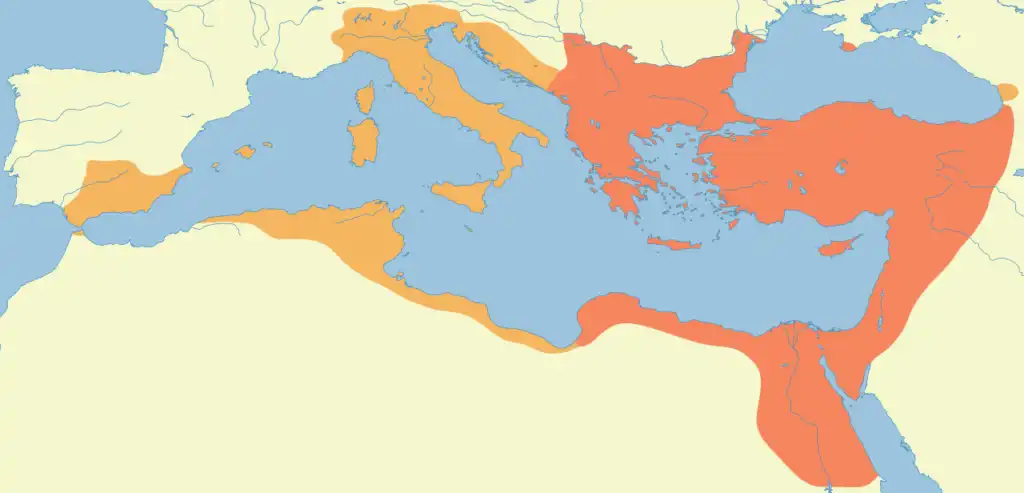
How Byzantium shaped Islamic and Western learning
Byzantium occupied a pivotal position between worlds. Greek-speaking scholars, operating in networks from Constantinople through Syriac centers such as Edessa and Harran to Abbasid Baghdad, carried Greek learning into the Arabic east, where translators helped build the great libraries of the Abbasid age. Medical and philosophical works passed through Syriac and Arabic into a new scientific dialogue. Centuries later, as the empire contracted, Greek émigrés brought manuscripts and expertise to Italy.
In the fifteenth century, the teacher Gemistos Plethon championed Plato in a Latin world long accustomed to Aristotle, influencing Renaissance thought and public debate. When printers in Venice issued Greek classics, they often relied on Byzantine copies corrected by editors trained in the same scholia that had once adapted pagan texts for Christian students.
The link between past and present is visible in modern scholarship as well. Many critical editions of Sophocles, Aeschylus, and Thucydides depend on Byzantine manuscript families and on marginalia that clarify rare words or variant lines. Editorial symbols and conventions used today echo Byzantine methods for marking doubtful readings. How should a society with strong religious commitments handle inheritance from a world of different values? Byzantium’s answer was pragmatic: contextualize, annotate, teach, and employ the past to serve the present without assuming the past fully agreed.
Examples abound. The survival of Euclid’s Elements in a stable form owes much to Byzantine copyists who standardized diagrams. The medical tradition that reached medieval hospitals passed through compilations attributed to Galen, carefully sifted and corrected in Greek workshops. Histories by Herodotus and Polybius survive with Byzantine summaries that guided later readers to key episodes of empire and diplomacy. What we now call “Classical” is often a Byzantine selection, stabilized by a taste for order and a need for administrative clarity.
Why Did Byzantium Preserve Pagan Texts in a Christian Empire? 2025 IUSTITIA.BG – Investigations 2009-2025 2025-12-22 17:10:00 Latest news, world news, country news, most important news, latest news, most important, latest of the day, Justice, Petar Nizamov, Feathers, Petar Nizamov- Feathers, Justice bg, iustitia.bg, iustitia, iusticia, usticia, investigation, Burgas, Bulgaria, news, breaking news, news of the day, news of today, news from today, Bulgaria news, The news from Bulgaria, blitz news, top news, most important, most commented, latest news, Boyko Borisov, news, weather, coronavirus, news, news, weather, facebook, youtube, facebook, instagram, today’s news, last minute news, news today, today’s news, news, bg news, leading news, hot news, bg news, news site, all news, news bg, last hour news, latest, latest news bg, news from today, news today, last hour news, latest news, today, news bg, news, news vesti, 24 hours news, vesti bg novini, world news, bird bg, bivol bg, bivol, trud bg novini, latest news today, novinite bg news, hello bulgaria, political party coat of arms, delyan peevski, scandalous, bulgarian national television, free europe, television, scandal, exclusive, live, live tv right now, tv, tv online, tv program, bg, live now, tv news, online, live tv online, court, burgas court, burgas district court, burgas court, burgas district court, burgas district court, burgas district court, burgas court of appeal, burgas prosecutor, burgas prosecutor’s office, burgas district prosecutor’s office, burgas district prosecutor’s office, chief prosecutor, ivan geshev, prosecutor geshev, tsatsarov, mvr burgas, odmvr burgas, odp burgas, police burgas, district police burgas, prosecutor tsatsarov, sgs cases, court varna, chairman of the Supreme Court of Justice, court decisions in civil cases, decisions in cases, Plovdiv court, court decision, case decisions, Varna court, criminal, cases, district, district court decisions, work in court, Supreme Court of Justice chairman, Supreme Court judges, Sofia court, deputy judges, Plovdiv, Plovdiv court, judges Plovdiv, Supreme Court, Inspectorate of the Supreme Court of Justice, Supreme Judicial Council, Supreme Court, Supreme Judicial Council, lawyer, lawyer criminal cases, lawyer civil cases, lawyer matrimonial cases, lawyer administrative, criminal law, criminal process, civil law, civil process, administrative law, constitutional law,