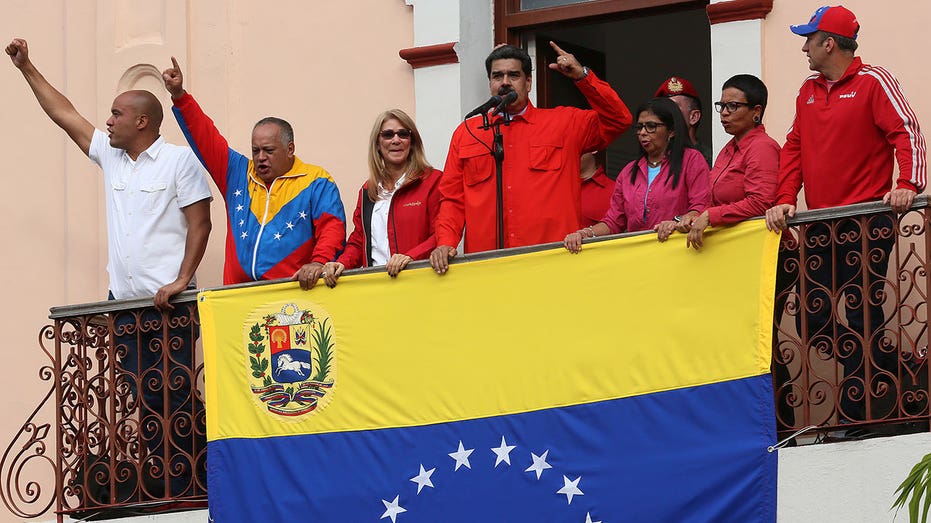
As Venezuela enters the post-Nicolas Maduro era, former officials and regional experts warn the country may be facing not a democratic transition, but a period of deeper instability and internal conflict between possible successors that some warn could be even worse than Maduro.
Marshall Billingslea, the former assistant secretary for terrorist financing and financial crimes in the U.S. Treasury Department, said Maduro’s removal has exposed a fractured system that was never held together by a single strongman, but by competing criminal power centers now moving independently.
“The cartel has always been a loose association, with each of the mafia bosses having their own centers of gravity,” Billingslea said. “Maduro was the frontman, but he didn’t exercise total control. Now we’re seeing each of those centers spinning off on their own.”
MADURO’S SON GIVES ‘UNCONDITIONAL SUPPORT’ TO NEWLY SWORN IN INTERIM VENEZUELA PRESIDENT
Billingslea said the capture of Cilia Flores, Maduro’s wife, was as consequential as Maduro’s removal itself.
“The capture of Cilia Flores is a particularly big deal because she was the brains behind the operation and the one who cleared out potential rivals,” he said. “Her removal is equally significant.”
TRUMP ISSUES DIRECT WARNING TO VENEZUELA’S NEW LEADER DELCY RODRÍGUEZ FOLLOWING MADURO CAPTURE
Billingslea outlined what he described as five competing power centers, four within the regime and one outside it. “The removal of Maduro, and particularly the removal of Cilia Flores, leaves a huge power vacuum in the cartel,” he said. “We haven’t yet reached a new equilibrium here.”
In the interim, he foresees a high risk of internal power struggles, violence and further repression as rival factions maneuver to secure control in a post-Maduro Venezuela. But he notes that the Trump administration anticipates this and is executing a clear-eyed strategy to first secure U.S. core interests, followed by the gradual restoration of democracy, all without needing American “boots on the ground.”
TRUMP VOWS US ‘IN CHARGE’ OF VENEZUELA AS HE REVEALS IF HE’S SPOKEN TO DELCY RODRÍGUEZ
Delcy Rodríguez, Maduro’s longtime vice president, was quickly installed as interim leader. But her rise has done little to reassure Venezuelans or international observers that meaningful change is coming.
Rodríguez is deeply embedded in the Maduro system and has long played a central role in overseeing Venezuela’s internal intelligence and security apparatus. According to regional reporting, her focus since taking office has been consolidating control within those institutions rather than signaling political reform.
Former U.S. and regional officials say Delcy Rodríguez’s rise has revived long-standing questions about who truly influences her decisions as she moves to consolidate power.
Those officials point to Rodríguez’s deep ties with Cuban intelligence, which helped build and operate Venezuela’s internal security and surveillance apparatus over the past two decades. Cuban operatives played a central role in shaping how the regime monitored dissent and protected senior leadership, embedding themselves inside Venezuela’s intelligence services.
At the same time, former officials say Rodríguez appears to be testing cooperation with Washington, creating uncertainty over how much leverage the United States actually holds. Some view her limited engagement with U.S. demands as tactical, aimed at buying time while she works to secure loyalty inside the regime and neutralize rival factions.
A former Venezuelan official previously told Fox News Digital that Rodríguez “hates the West” and represents continuity with the Maduro regime, not a break from it.
Diosdado Cabello, one of the most feared figures in the country, has emerged as a central player in the post-Maduro scramble for control.
Cabello, who wields influence over the ruling party and interior security, has been rallying armed colectivos and loyalist groups. Those groups have been active in the streets, detaining opponents and reinforcing regime authority through intimidation.
Sanctioned by the U.S. Treasury for corruption and alleged ties to drug-trafficking networks, Cabello is widely viewed as a figure capable of consolidating power through force rather than institutions.
Jorge Rodríguez, president of the National Assembly and brother of Delcy Rodríguez, remains one of the regime’s most important political operators.
Rodríguez has served as a key strategist for Maduro, overseeing communications, elections and internal coordination. Recent reporting indicates he continues to work closely with his sister to maintain control over intelligence and security structures, reinforcing the regime’s grip despite Maduro’s removal.
Experts say Rodríguez could play a central role in shaping any managed transition that preserves the system Maduro built.
TRUMP’S VENEZUELA STRIKE SPARKS CONSTITUTIONAL CLASH AS MADURO IS HAULED INTO US
Defense Minister Vladimir Padrino López, long considered the backbone of Maduro’s survival, remains a critical figure as well.
While Padrino López has not publicly positioned himself as a successor, analysts note that the armed forces are no longer unified behind a single leader. Senior generals are split across competing factions, raising the risk of internal clashes or a shift toward overt military rule if civilian authority weakens further.
Beyond the power struggle among regime elites, Venezuela faces a broader danger.
Large parts of the country are already influenced by criminal syndicates and armed groups. As centralized authority weakens, those actors could exploit the vacuum, expanding control over territory and smuggling routes.
Experts warned that an uncontrolled collapse could unleash forces more violent and less predictable than Maduro’s centralized repression, and the events unfolding now suggest that risk is growing.
Outside the regime, opposition leader María Corina Machado remains the most popular political figure among Venezuelan voters. But popularity alone may not be enough to translate into power.
Machado lacks control over security forces, intelligence agencies or armed groups. As repression intensifies and rival factions maneuver, her ability to convert public support into political authority remains uncertain.
Maduro’s fall, analysts say, did not dismantle Venezuela’s power structure. It fractured it.
With armed loyalists in the streets, rival factions competing behind the scenes, and an interim leader struggling to assert authority, Venezuela now faces a dangerous period in which the aftermath of Maduro’s rule could prove more chaotic — and potentially more brutal — than what came before, experts say. For Venezuelans, the question is no longer whether Maduro is gone, but whether anything that replaces him will be better.
After Maduro, Venezuela power vacuum exposes brutal insiders and enforcers 2026 IUSTITIA.BG – Investigations 2009-2025 2026-01-06 16:30:47 Latest news World news Country news Most important news latest news most important latest of the day Justice Petar Nizamov Feathers Petar Nizamov- Feathers Justice bg iustitia.bg iustitia iusticia usticia investigation Burgas Bulgaria news news of the last hour news of the day news of today Bulgaria news The news from Bulgaria blitz news top news most important most commented latest news Boyko Borisov news weather coronavirus news news weather facebook youtube facebook instagram news today news of the last minutes news today today news news bg news leading news hot news bg news site for news all news news bg news of the last hour latest latest news bg news of today news today news today news of the last hour latest news today news bg news news 24 hours news vesti bg novini news world bird bg bivol bg bivol trud bg novini latest news today novinite bg news hello bulgaria political party coat of arms delyan peevski scandalous Bulgarian National Television Free Europe Television scandal exclusive live tv live right now tv tv online tv program bg live now tv news online tv online live court Burgas court Burgas district court Burgas court Burgas district court Burgas district court Burgas appellate court Burgas prosecutor Burgas prosecutor’s office Burgas district prosecutor’s office Burgas district prosecutor’s office Burgas district prosecutor’s office Burgas district prosecutor’s office Burgas district prosecutor’s office Burgas district prosecutor’s office Prosecutor General Ivan Geshev Prosecutor Geshev Tsatsarov Ministry of Internal Affairs Burgas ODMR Burgas ODPR Burgas police Burgas district police Burgas prosecutor Tsatsarov SGS cases Varna court chairman of the SGS court decisions on civil cases decisions on cases Plovdiv court decision of the court decisions cases Varna court criminal cases district district court decisions work in the court SGS chairman of the SGS judges Sofia court post judges Plovdiv court Plovdiv judges Plovdiv Supreme Court Inspectorate Supreme Court Supreme Judicial Council lawyer lawyer criminal cases lawyer civil cases lawyer marriage cases lawyer administrative criminal law criminal process civil law civil process administrative law constitutional law