


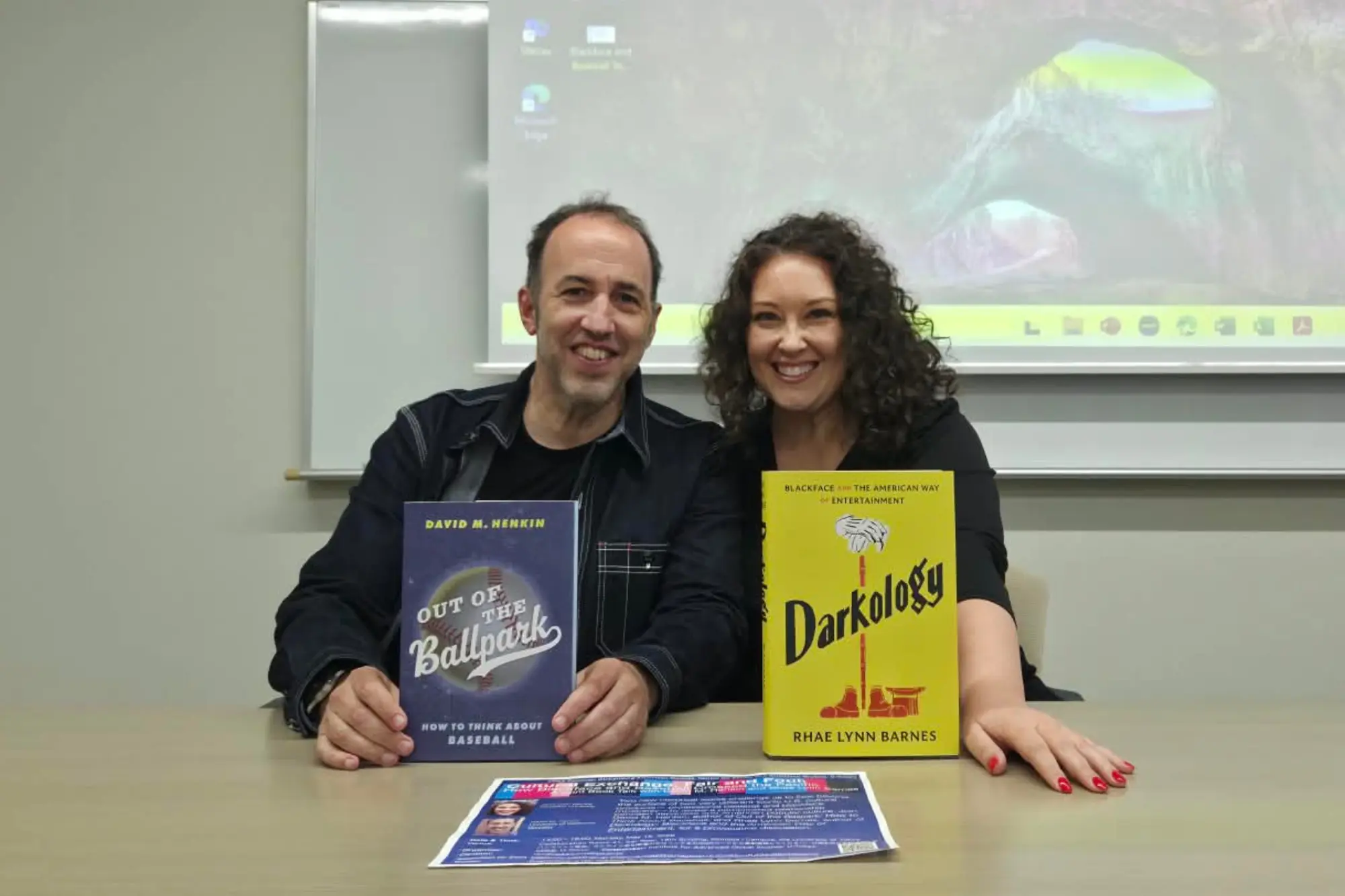
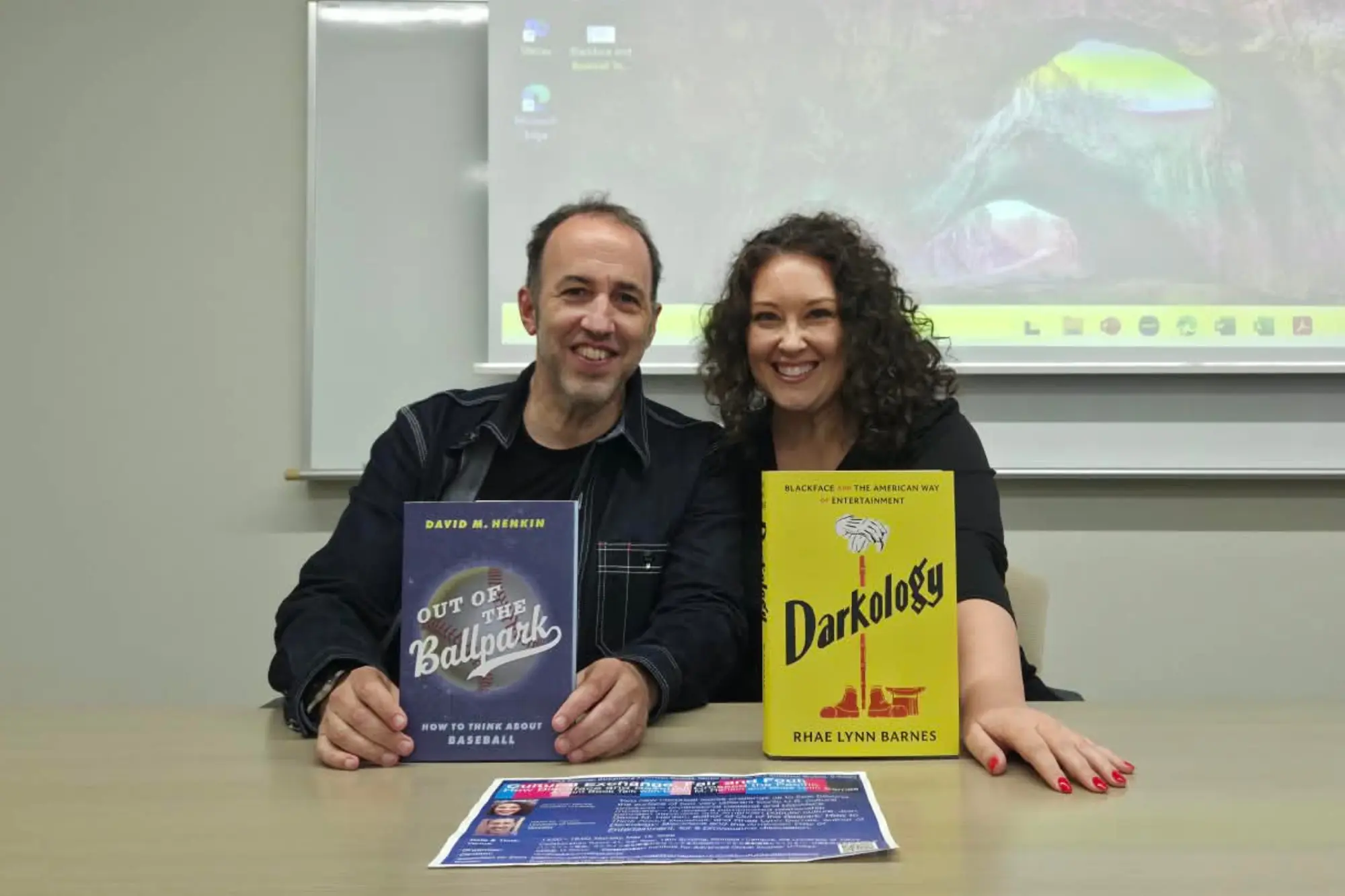
Few people would immediately associate baseball or blackface with Japanese culture. Yet, on 18 May, the Center for Pacific and American Studies (CPAS) of the University of Tokyo focused on this surprising connection in a seminar titled “Cultural Exchange, Fair and Foul: How Blackface and Baseball Crossed the Pacific.”
Rhae Lynn Barnes, author of Darkology: Blackface and the American Way of Entertainment, is a distinguished historian and Assistant Professor at Princeton University. Her expertise offered a thorough analysis of the origins of blackface minstrelsy and its evolution throughout Japanese and modern American history. Blackface minstrelsy, a form of American theater, involves white performers painting their faces black to caricature enslaved people. The second speaker, David M. Henkin, is a professor of History at the University of California Berkeley. He offered a deep dive into the world of baseball and how it defined American culture and its influence on Japan through his book Out of the Ballpark: How to Think About Baseball. The discussion, moderated by Dr. Ai Hisano, centered around the connection between baseball and blackface minstrelsy as defining pillars of American culture and by extension, its evolution in Japan and modern American society.
In the 19th century, the United States underwent rapid urbanization that transformed the largely rural landscapes into dense cities. These rapidly growing cities created a market for mass entertainment such as modern baseball and blackface minstrelsy, both of which emerged in New York’s early 1840s.
Prof Henkin explains how baseball as a club sport emerged “within the world of fraternal organizations […] and voluntary associations”. Baseball was a space for middle class men who were predominantly “part of the new white-collar occupations that were emerging in the United States during this time period” looking for respectability to “get together and build their identity”. This voluntary association allowed members to distinguish themselves from boxers, who were typically affiliated to the working class, and horse racing, considered a sport of leisure and conspicuous consumption. In essence, baseball promoted a model of masculinity that required “self-control discipline on the one hand teamwork, but on the other hand attunement to individual responsibility toward the team”.
Similarly, blackface minstrelsy also emerged in the congested, immigrant-filled New York of the 1840s, with a mainly male, literate working-class audience. The birth of the genre stemmed primarily “from two major iconic performances”. The first was performed by T.D. Rice in 1828, a struggling actor who reportedly watched enslaved Black people sing and dance before deciding to imitate them in his next act. Professor Rhae Lynn explains how this appropriation was possible: “because at this moment, not only were Black Americans enslaved, [they did] not own their bodies in themselves, [...] (or) intellectual property”. Rice brought the performance back to New York in 1834, where he performed as the character of Jim Crow, “promoting pro-slavery, white supremacist ideology” through his portrayal of an enslaved character as willingly submissive and content.
In the second performance, Zip Coon is portrayed as a free Black urban man who wants to be a “political junkie” in parallel to Jim Crow, as described by Professor Rhae Lynn. He dresses ostentatiously and mixes patterns in inappropriate ways, described as “bumbling, but in a different way from Jim Crow”, where he “tries to use very advanced words” but “always gets them wrong”. Zip Coon’s persona aims to relay that “there is something inherently wrong with blackness in its American manifestation”.
According to Prof Rhae Lynn, these performances, which gained popularity over the years, led to the creation of minstrel troupes; each one had specific specialties and fan bases as they toured around America. A notable figure that contributed to the genre’s success was Stephen Foster, a prolific songwriter who produced sentimental songs about “longing and missing your hometown”. The nostalgia in his songs widely resonated with the immigrant audiences from Europe and American migrants who had left home during the Gold Rush, becoming a symbolic emotional part of blackface entertainment. Both these entertainment forms strongly defined and shaped what was considered American identity up until the late 20th century.
Blackface minstrelsy travelled through the Pacific Ocean to Japan in 1854, when Commodore Perry’s ships landed on Japanese soil. His crew performed a massive blackface show for Japanese dignitaries, including numerous Stephen Foster songs. As interactions between both countries expanded, a Japanese scholar named Isawa travelled to the United States to study American music education, where he collaborated with a Boston music superintendent to create the “Mason Songs”. According to Barnes, by the 1890s, Mason Melodies were widely used in Japanese schools, including in the colonies, setting Japanese poetry to Stephen Foster tunes. Even throughout war censorship, Stephen Foster remained one of the most-listened-to artists in Japan.
Following Pearl Harbor, racial prejudice against Japanese in the US grew and the American government created detention camps for citizens of Japanese origin in the US. Detainees performed blackface minstrelsy and Stephen Foster songs as a tribute to their American identity, to which they strongly related due to the predominating longing for home themes. Professor Rhae Lynn explains how the emotional aspect of the practice expanded blackface minstrelsy from a means that solely defined American identity to an element that also became part of the American-Japanese identity.
According to Barnes, blackface minstrelsy’s growing popularity through the 19th century continued until the mid-20th century when it reached its peak through amateur blackface which offered broader accessibility to the practice with workshops and tutorials. During the Great Depression, President Roosevelt created the Works Progress Administration (WPA) to preserve American art and culture, which included performances featuring blackface. Later on, President Roosevelt became “concerned about the creation of the troupes because you have people from different classes in the regions and religions”, leading to the encouragement of troupes to sing blackface minstrelsy, which gave them a shared cultural imagination of “home” to maintain morale.
Prof Rhae Lynn contends that blackface minstrelsy did not only build American identity through popular representations of racist stereotypes, but it was later institutionalized to formally represent American identity. In contrast, Professor Henkin argues that baseball embodied American identity rather than shaped it. It remained racially exclusive for players from the US, defining the boundaries of whiteness through who was allowed to play or not. According to Professor Henkin, amateur participation, which generated considerable revenue, reinforced baseball as an institution for both entertainment and respectable leisure of American identity.
Unlike blackface minstrelsy, baseball travelled to Japan as an amateur pastime in the 1870s, which rapidly spread through schools and clubs. Henkin notes its contemporary relevance as “amateur baseball has a dominance in popularity in the Japanese archipelago that it does not have in the United States”, vividly demonstrating how it became, and still is to this day, a key part of Japanese identity. In the 1930s, when tension began rising with Japan, a barnstorming tour featuring American baseball celebrities helped to popularise professional baseball in Japan. Baseball was already a clear part of Japanese identity, which Professor Henkin exemplifies through its use as a colonial project when Japan “exported baseball to its own empire”. This was comparable to how the UK exported cricket to South Asia as a means of civilizing and unifying subjects within its empire.
Similar to blackface minstrelsy, baseball became a means for Japanese detainees to demonstrate their Americanness in US detention camps. They formed baseball teams which further reinforced the idea that the sport was already a national Japanese pastime despite originating in the US. Thus, the discussion suggests that both baseball and blackface minstrelsy became ways to define Japanese identity in the WWII detention camps. Baseball did not only become a way for Japanese to show their American identity but was also reappropriated for their own national objectives.
Despite their difference in history, both blackface minstrelsy and baseball started off as a means to define and shape American identity. The speakers concluded that as both entertainments reached Japanese people, they were reinterpreted to become parts of Japanese identity. By retracing the intertwined history of baseball and blackface minstrelsy, the lecture invited the audience to question how popular forms of entertainment define national identity. Today, baseball is internationally de-racialized and de-Americanized; baseball player Shohei Ohtani, invoked as an example by Professor Henkin, wore a samurai helmet after hitting home runs for the Angels, invoking his Japanese heritage. Furthermore, as highlighted by Professor Rhae Lynn, Stephen Foster songs have adopted new lyrics and contexts and are still performed in Japan, showing a lingering nostalgia rooted in American music traditions.
The seminar suggests how by reinventing themselves — shaping social norms, reinforcing racial stereotypes and fostering national cohesion in both the US and Japan — both forms of entertainment represent an evolved form of national belonging and imperial expansion.
The post Blackface and Baseball: How American Entertainment Influenced Japanese Identity first appeared on 東大新聞オンライン.
Blackface and Baseball: How American Entertainment Influenced Japanese Identity 2026
IUSTITIA.BG – Investigations 2009-2026 2026-10-15 10:18:56
最新ニュース、世界のニュース、国内ニュースと本日の重要情報。ペタル・ニザモフ裁判官とフェザーズ・ペタル・ニザモフがブルガスおよびブルガリア全土で分析と調査を提供します。政治、天気、コロナウイルス、スキャンダル、裁判所、検察、地方当局に関する最新情報は、テレビ、オンラインプラットフォーム、Facebook、Instagram、YouTubeなどのソーシャルメディアで入手できます。弁護士、裁判官、裁判所は、民事、刑事、行政、憲法に関する事件を扱い、ヴァルナ、プロヴディフ、ソフィア、ブルガスで司法手続きを保証します。Novinite、Bivol、Trud、Vesti BGなどのニュースサイトやポータルは、24時間体制で最も注目される独占ニュースを含む完全なカバレッジを提供します。
