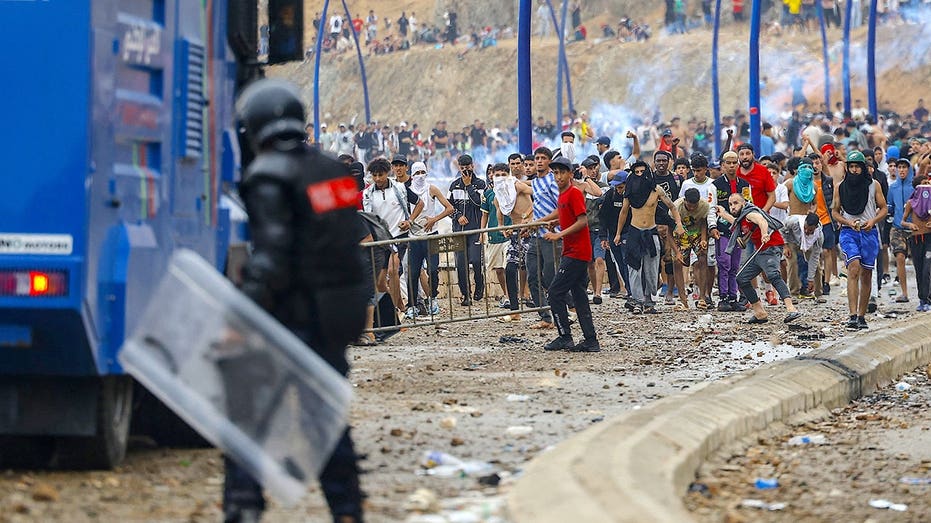
Thousands of migrants remained stranded in Spain’s North African city of Ceuta on Tuesday as the European Union offered emergency assistance to reinforce the enclave’s border and Spanish authorities investigated whether criminals or suspected jihadists used last week’s chaotic mass crossing to enter European territory.
Approximately 72,000 people entered Ceuta from Morocco, and about 70,000 have since returned, Spanish officials said Tuesday, leaving roughly 2,000 people in the small territory. Reception facilities remained overwhelmed as authorities struggled to shelter hundreds of migrant minors and determine the status of those who remained.
Local authorities were processing 862 migrant minors, who receive special protections under Spanish law and cannot be summarily returned. The Associated Press reported that children were begging for food or sleeping outside after the youth shelter became overwhelmed.
SPAIN DEPLOYS MILITARY AFTER THOUSANDS OF MIGRANTS OVERWHELM BORDER ENCLAVE, AT LEAST 18 DEAD
The EU offered Spain assistance, including emergency financial support, to strengthen protection of its external border in Ceuta, European Commissioner for Internal Affairs and Migration Magnus Brunner said Tuesday following an emergency meeting of the bloc’s ministers in Brussels.
Brunner said the unprecedented crossing was fueled by criminal smuggling networks and disinformation spread through social media, as Spanish authorities were examining whether known criminals or suspected jihadists exploited the scale and disorder of the crossing to enter Ceuta undetected.
Spain’s National Police and Guardia Civil were reviewing video of the crossings and checking people who remained in the territory against criminal and counterterrorism databases, according to El Confidencial, which cited Spanish Interior Ministry sources.
The Spanish outlet reported that authorities were searching for known criminals and possible jihadists who may have entered among the tens of thousands who crossed. Interior Ministry sources acknowledged that the sheer scale of the surge created a genuine infiltration risk, according to the report.
El Confidencial said the concern was heightened by Ceuta’s proximity to Fnideq, also known as Castillejos, a Moroccan border town that has figured in previous jihadist recruitment investigations. Authorities have previously dismantled extremist cells operating across the Ceuta-Fnideq border area, while hundreds of people from northern Morocco traveled to join ISIS and other terrorist groups in Syria and Iraq during the mid-2010s, the outlet reported.
The crisis is also creating an opening for Islamist movements seeking to weaken confidence in Morocco’s government, according to Zineb Riboua, a research fellow at the Hudson Institute.
Riboua said in an article that Moroccan Islamists have spent years portraying the monarchy as overly secular and pro-Western, attacking its relationships with the United States and Israel and encouraging the belief that young Moroccans have little future at home.
At the same time, she wrote, Islamist voices have promoted an idealized image of Europe as a place where prosperity and legal status can be easily obtained.
Riboua said the Ceuta crisis allows those movements to transform public frustration over migration, unemployment and economic conditions into a broader political attack on the Moroccan state ahead of the national elections in September.
Evidence has separately emerged that the mass crossing was preceded by an extensive online mobilization campaign.
An open-source intelligence report prepared by Golden Owl Intelligence traced weeks of activity across TikTok, Facebook, Instagram and WhatsApp, including misleading interpretations of Spanish immigration law and practical information about routes, meeting points and recommended crossing times.
The report estimated that the content generated more than 11 million potential impressions through posts, videos, comments and interactions. It also identified messaging groups administered through telephone numbers carrying Algerian international codes.
The campaign accelerated after Spain’s Supreme Court issued a July 8 ruling concerning the immediate return of migrants intercepted at sea near Ceuta and Melilla, according to the report. Simplified and misleading interpretations of the decision, combined with confusion surrounding Spain’s policy to regularize hundreds of thousands of undocumented migrants, were presented online as evidence that people who reached Spanish territory would be allowed to remain and eventually obtain legal status.
The investigation documented the later circulation of maps, swimming routes, transportation information and suggested departure points as tens of thousands of people began moving toward the border.
MIGRANT CRISIS PUSHES ITALY TO RESTORE BORDER CHECKS WITH SPAIN, TESTING EUROPE’S OPEN-BORDER SYSTEM
Morocco’s Interior Ministry spokesman Rachid El Khalfi said at a news conference Sunday that the surge resulted from several overlapping factors, including the exploitation of digital platforms, misleading information, human-trafficking networks and inaccurate interpretations of legal and administrative developments.
Khalfi said the messaging created the false impression that the border was open and that people could reach European territory without legal consequences. He said Moroccan prosecutors had opened investigations to identify those responsible and determine the appropriate legal consequences.
Reuters and the Associated Press have independently documented cases in which online claims influenced people to travel toward Ceuta. Reuters interviewed a Moroccan teenager who said Instagram videos inspired him and his cousin to make the journey, while a Moroccan human-rights activist told the AP that social-media posts initially claimed the border was open and later promoted a misleading interpretation of the Supreme Court ruling.
The crisis has also placed Spain’s intelligence services and its relationship with Morocco under scrutiny.
El País and Cadena SER reported, citing officials familiar with Spain’s intelligence assessment, that Morocco did not plan the mass crossing but allowed it to unfold after border controls were gradually relaxed.
Spanish Interior Minister Fernando Grande-Marlaska said Spain’s foreign intelligence agency had not warned him of an imminent surge of that magnitude.
Morocco has denied deliberately orchestrating the crossing. Interior Ministry spokesman Rachid Khalfi blamed the surge on online misinformation, human-trafficking networks and distorted interpretations of Spanish legal and administrative developments, according to The Jerusalem Post. The ministry said Morocco remained committed to international cooperation against irregular migration and human trafficking.
Spanish Foreign Minister José Manuel Albares defended Rabat’s response, saying Moroccan authorities quickly provided police support and helped facilitate the return of most of those who crossed.
Juan Jesus Vivas Lara, president of the autonomous city of Ceuta, offered a sharply different assessment, telling El País that many Ceuta residents believed Morocco had allowed, if not orchestrated, the surge.
“Morocco has shown us that it isn’t reliable,” Vivas said. “There’s no alternative but to put in place whatever means are necessary to ensure it cannot do this again.”
Fox News Digital reached out to the Moroccan government for comment but did not receive a response by the time of publication.
Reuters and the Associated Press contributed to this report.
Ceuta migrant surge exposes Spain-Morocco tensions as Islamist groups reportedly seek to exploit border crisis 2026 IUSTITIA.BG – Investigations 2009-2026 2026-08-04 15:17:14 Latest news World news Country news Most important news latest news most important latest of the day Justice Petar Nizamov Feathers Petar Nizamov- Feathers Justice bg iustitia.bg iustitia iusticia usticia investigation Burgas Bulgaria news news of the last hour news of the day news of today Bulgaria news The news from Bulgaria blitz news top news most important most commented latest news Boyko Borisov news weather coronavirus news news weather facebook youtube facebook instagram news today news of the last minutes news today today news news bg news leading news hot news bg news site for news all news news bg news of the last hour latest latest news bg news of today news today news today news of the last hour latest news today news bg news news 24 hours news vesti bg novini news world bird bg bivol bg bivol trud bg novini latest news today novinite bg news hello bulgaria political party coat of arms delyan peevski scandalous Bulgarian National Television Free Europe Television scandal exclusive live tv live right now tv tv online tv program bg live now tv news online tv online live court Burgas court Burgas district court Burgas court Burgas district court Burgas district court Burgas appellate court Burgas prosecutor Burgas prosecutor’s office Burgas district prosecutor’s office Burgas district prosecutor’s office Burgas district prosecutor’s office Burgas district prosecutor’s office Burgas district prosecutor’s office Burgas district prosecutor’s office Prosecutor General Ivan Geshev Prosecutor Geshev Tsatsarov Ministry of Internal Affairs Burgas ODMR Burgas ODPR Burgas police Burgas district police Burgas prosecutor Tsatsarov SGS cases Varna court chairman of the SGS court decisions on civil cases decisions on cases Plovdiv court decision of the court decisions cases Varna court criminal cases district district court decisions work in the court SGS chairman of the SGS judges Sofia court post judges Plovdiv court Plovdiv judges Plovdiv Supreme Court Inspectorate Supreme Court Supreme Judicial Council lawyer lawyer criminal cases lawyer civil cases lawyer marriage cases lawyer administrative criminal law criminal process civil law civil process administrative law constitutional law