


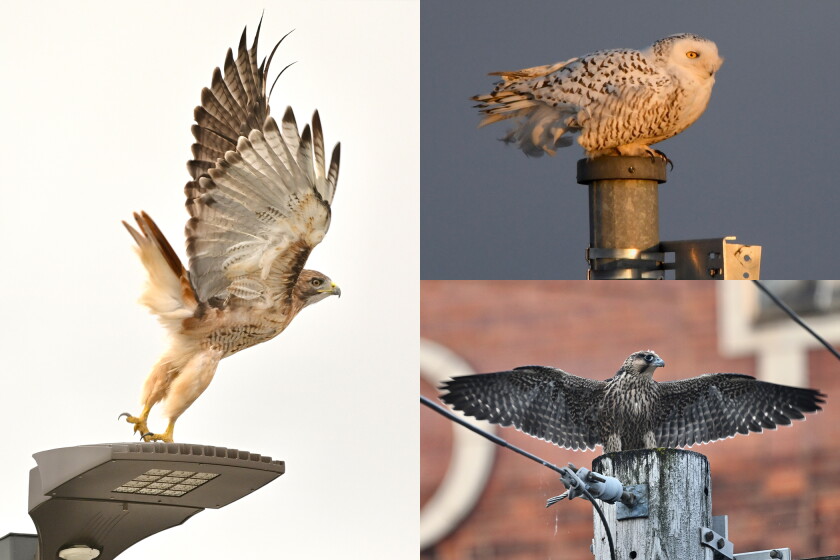
Street lights are designed to improve safety, helping drivers see adequately at nighttime.
But they’ve also become a symbol of how some birds of prey have been adapting to the Chicago region.
Much like coyotes who have figured out how to live, hunt and grow in a metropolitan area of nearly 10 million people, certain raptors have found a way to survive here, and in some instances thrive, while enlisting the help of the towering street lamps and similar infrastructure, including cell phone towers and electric poles.
Drive long enough on Chicago-area highways or tollways and motorists may see a red-tailed hawk or a Cooper’s hawk, or at times something more exotic, perched high above the pavement on a light pole taking a rest or eyeing the medians and shoulders for the movement of a squirrel, rabbit, songbird or any other creature that could be a meal.
That means on the Kennedy Expressway near Addison Street, where a hawk has been spotted on and off for a decade, sometimes while traffic crawls below during rush hour.
Hawks have also been spotted along the Tri-State Tollway in the Rosemont area not far from O’Hare Airport, and along the Jane Addams Memorial Tollway in the outer rings of suburbia.
Within the last couple of weeks, a bald eagle was seen landing and perching atop a wooden utility pole along busy Half Day Road in the Long Grove area, causing some drivers to slow and take a look at the majestic bird until it took flight again.
In addition to hawks, amateur wildlife photographer Jeff Nelson has spotted owls, osprey and peregrine falcons on poles in the region and elsewhere in northern Illinois in recent years.
He’s captured photos of them in or near Downers Grove, La Grange, Orland Park and Chicago’s Near North and South sides, as well as elsewhere in Illinois.
The poles don’t just give some of the birds an obvious perch to hunt from over our generally flat terrain, experts say.
They also provide a spot to eat. Cook County Forest Preserve District wildlife biologist Chris Anchor said the height eliminates some of the risk that another predator will try to snatch their food. What’s more, he said, the top of the tall lights are sturdy.
“Because they don’t have teeth like we do, they have to rip things apart, so they have to find a place — a lot of times they’ll use a fence pole or a light pole as a cutting block,” Anchor said.
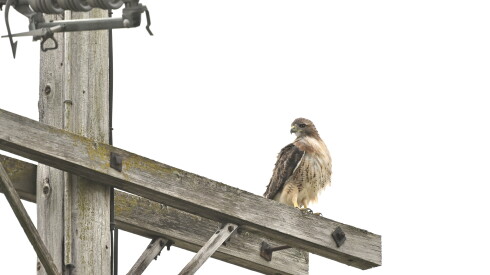
“They’ll hold their prey in their talons and rip with their beak while they’re supporting it against the light pole or fence pole. It gives them a mechanical advantage to rip the prey apart.”
And with some poles emanating light, they attract bugs, which some birds of prey eat. Even if they don’t, the bugs can attract other birds, or even mammals, which the raptors may feed on.
“It’s the whole food chain meeting up at the light pole,” Anchor said. “It’s like the rally point.”
A spokesman for the Illinois Department of Transportation, which builds and maintains freeways across the state, said, “There is no standard mounting height on light poles. In general, the most common height on IDOT roads is 45 feet, with District 1” that covers Cook and the collar counties “typically at 47.5 feet.”
“On interchanges with high-mast towers, around 80 to 100 feet is common. On larger, complex interchanges, they can exceed that height.”
There are roughly 30,000 light poles in the metro area along IDOT roads, according to the agency.
State tollways have nearly 15,000 poles, an official said.
There are at least 700 major cellular towers in Illinois, according to a public database.
Vic Berardi, a board member of the Hawk Migration Association among other bird advocacy groups, recently wrote in Natural Awakenings Chicago magazine: “A remarkable and unexpected comeback is underway for a bird that once teetered on the edge of extinction. The osprey is returning to northeastern Illinois — and in surprising fashion, it’s nesting atop cell phone towers, especially in Lake County.”
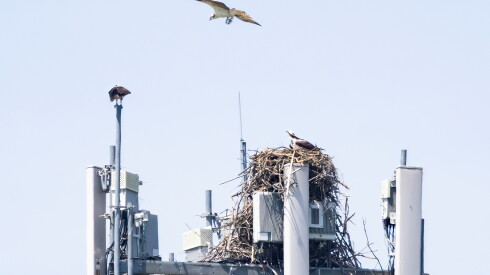
“In 2020, only a few osprey nests were known to be on cell towers in Lake County. By 2025, at least 26 active nests have been confirmed in Lake and McHenry counties, with new ones being discovered regularly.”
Berardi added: “Many of nature’s creatures, including the osprey, are becoming increasingly dependent on human-altered environments. The upside is that we get to witness their lives up close. The downside is that we bear greater responsibility to protect and sustain the habitats they now rely on.”
A spokesperson for Verizon, the cellular carrier, said: “We currently have one site in the Chicago area with an active bird nest believed to contain ospreys.”
“If an osprey, a protected species, nests on a site, we are prohibited from climbing or performing work on the tower while it is active without an exemption from the U.S. Fish and Wildlife Service to remove the birds, which is rarely granted when eggs or younglings are present. We work with biologists to ensure we care for environmental resources.”
Many birds of prey were almost wiped out in the U.S. decades ago because of, among other reasons, the use of toxic chemicals such as DDT that weakened their eggshells and then their ability to reproduce. Some species have made remarkable comebacks in the Chicago area and elsewhere, including the bald eagle, while others may be better off than before but are still struggling.
A 2025 paper by researcher Vladimir Dinets concluded: “Urban birds often develop remarkable behavioral adaptations to their complex and challenging environment.”
The research involved Dinets watching a young Cooper’s hawk hunting by a busy intersection in New Jersey.
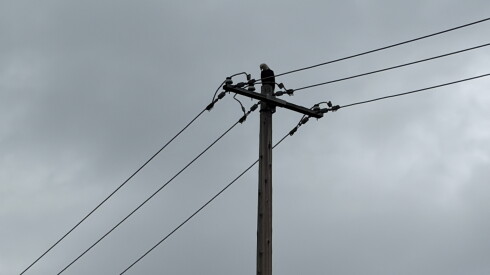
“The bird seemed to understand that, whenever a human pushed the pedestrian crossing signal, a long line of cars would back up down the street,” according to a Smithsonian magazine account of the study. “The savvy creature then used the vehicles as cover to launch a sneak attack on a group of unsuspecting birds gathered in a nearby home’s front yard.”
There are dangers associated with raptors living and hunting in areas with large human populations and infrastructure, including when poles or metal towers accompany power wires and birds make the wrong kind of contact with them or other electrified components. They can be hurt or killed.
Utility companies in Illinois have been installing markings on some lines to avoid bird collisions, while putting other non-conductive objects on or near poles to lessen the chance of electrocution, officials said.
It’s about helping the birds, but it’s also important in reducing outages.
Julie Heath, director of Boise State University’s Raptor Research Center, said other dangers come with birds of prey hunting near roads, including getting struck by vehicles, which has been known to especially happen with barn owls.
An Idaho study of American kestrels, a type of falcon, also found stress hormone levels were higher in the birds that lived near roadways, and they were more likely to abandon their nests, which can impact their breeding, Heath said.
Meantime, commercially available poisons used to kill rodents also remain troublesome for raptors, which may eat the poisoned creatures and then become sick or die.
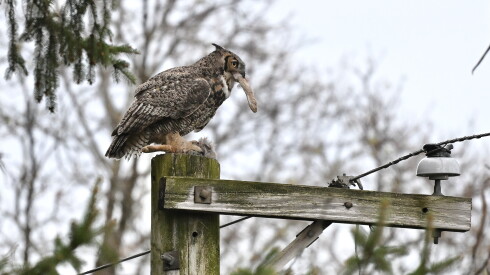
So even if there’s enough food sources somewhere to sustain raptors, and “many thrive,” it’s not as simple as thinking, “They’re there, they must be good,” Heath said.
Candy Ridlbauer of the Northern Illinois Raptor & Education group near Rockford said grassy medians and shoulders along roads are nicknamed “corridor cafes” for the birds of prey given the creatures that are often there that can be eaten. But there are a lot of “hazards being that close to roadways,“ principally cars and trucks, she said.
Jacques Nuzzo, executive director of the Illinois Raptor Center in downstate Decatur, said red-tailed hawks weren’t as decimated as other raptors historically, and they’re great at adapting based on need.
“Why go off and hunt in the woods when you can hunt voles all day long … in the median of a highway,” Nuzzo said, referring to a type of rodent. “There’s tons of food there.”
“That’s the nature of a bird of prey: They’re opportunists. They’re going to take advantage of any situation that arises.”
Studies have shown many songbirds in the U.S. are facing an alarming, precipitous drop in numbers, largely because of human factors, including destruction of habitat, pollution and pesticides.
Locally, even the number of American robins seems to be declining, while more of those birds appear to be staying put longer in the region rather than migrating in the colder months.
Many raptors in Illinois have seen their numbers rise since the 1960s as the worst toxins were phased out, even if some of the bird populations have been leveling off or declining more recently.
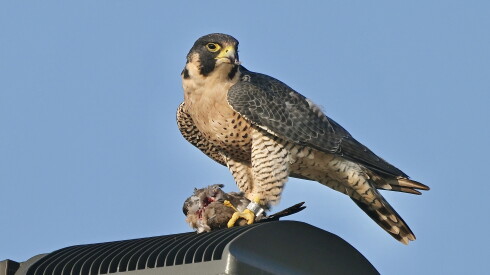
The number of bald eagles logged in Illinois in the Audubon Christmas Bird Count has risen more than 5% annually between 1966 and 2023.
Cooper’s hawks are up roughly 3.6% annually during that same time period, but their numbers have been sliding the last 10 years of that survey. Likewise, the number of red-tailed hawks is up less than 1% annually during the same time, though between 2013 and 2023 they began to mark a decline in Illinois.
Certain types of owls also have been steadily rising, according to the survey.
Peregrine falcons have been the subject of a well-publicized reintroduction program in Chicago that now has a number of them living atop high-rises, and hunting pigeons and other creatures with their lightning speed.
“You’re seeing a very nuanced story about how raptors have this interesting relationship with humanity,” said Bryce Robinson of the Cornell Lab of Ornithology. “A lot of species have been able to adapt to the human presence.”
While there are “some benefits” to the developed landscape, “with those come a lot of negative impacts.”
IUSTITIA.BG – Investigations 2009-2026 2026-10-12 11:20:01
Latest news World news Country news Most important news latest news most important latest of the day Justice Petar Nizamov Feathers Petar Nizamov- Feathers Justice bg iustitia.bg iustitia iusticia usticia investigation Burgas Bulgaria news news of the last hour news of the day news of today Bulgaria news The news from Bulgaria blitz news top news most important most commented latest news Boyko Borisov news weather coronavirus news news weather facebook youtube facebook instagram news today news of the last minutes news today today news news bg news leading news hot news bg news site for news all news news bg news of the last hour latest latest news bg news of today news today news today news of the last hour latest news today news bg news news 24 hours news vesti bg novini news world bird bg bivol bg bivol trud bg novini latest news today novinite bg news hello bulgaria political party coat of arms delyan peevski scandalous Bulgarian National Television Free Europe Television scandal exclusive live tv live right now tv tv online tv program bg live now tv news online tv online live court Burgas court Burgas district court Burgas court Burgas district court Burgas district court Burgas appellate court Burgas prosecutor Burgas prosecutor’s office Burgas district prosecutor’s office Burgas district prosecutor’s office Burgas district prosecutor’s office Burgas district prosecutor’s office Burgas district prosecutor’s office Burgas district prosecutor’s office Prosecutor General Ivan Geshev Prosecutor Geshev Tsatsarov Ministry of Internal Affairs Burgas ODMR Burgas ODPR Burgas police Burgas district police Burgas prosecutor Tsatsarov SGS cases Varna court chairman of the SGS court decisions on civil cases decisions on cases Plovdiv court decision of the court decisions cases Varna court criminal cases district district court decisions work in the court SGS chairman of the SGS judges Sofia court post judges Plovdiv court Plovdiv judges Plovdiv Supreme Court Inspectorate Supreme Court Supreme Judicial Council lawyer lawyer criminal cases lawyer civil cases lawyer marriage cases lawyer administrative criminal law criminal process civil law civil process administrative law constitutional law

