


What does cooperation between Japan, a “giant” of innovation in Asia, and the world’s largest defence alliance look like? Amid rising global tensions, the head of the North Atlantic Treaty Organization’s (NATO) defence industry division visited Komaba II Campus to offer an answer: Japan has much to offer in the field of technology, and cooperation could also bring economic benefits to the nation.
On 15 May, the University of Tokyo hosted Ms. Tarja Jaakkola, Assistant Secretary General (ASG) for Defence Industry, Innovation and Armaments at NATO. She appeared for a symposium titled “Japan-NATO Cooperation in an Era of Emerging Technologies: Policy Coordination, Institutional Design, and Dual-Use Innovation,” which was co-hosted by the Economic Security Intelligence Lab (ESIL) at UTokyo’s Research Center for Advanced Science and Technology (RCAST), and the Indo-Pacific & Euro-Atlantic Hub for Shared Security Challenges, with support from NATO HQ. Among those joining her on the stage were the event’s moderator, Project Lecturer Akira Igata, and Professor Yee Kuang Heng from the Graduate School of Public Policy at UTokyo.
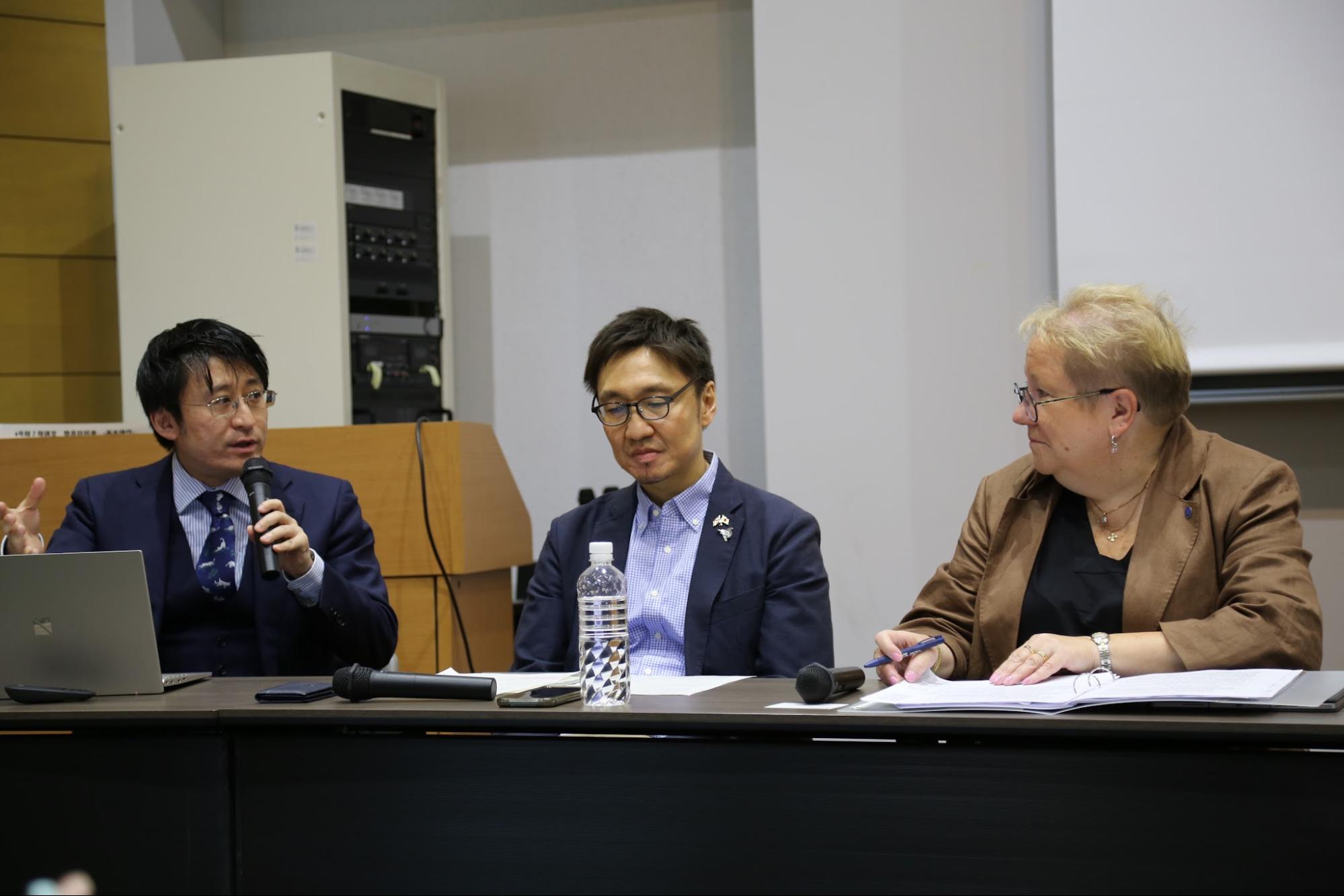
The core of Ms. Jaakkola’s keynote presentation focused on integrating advanced civilian innovation into military capabilities to tackle global challenges, such as those witnessed in Ukraine. Furthermore, she advocated for a shift in how society views defence, preferring the term “defence investment” over “defence spending”, thereby framing such expenditure as a necessary commitment to sovereignty and peace. For countries like Japan, where increases in defence expenditure often face domestic opposition, this framing reflects NATO’s broader effort to justify greater investment in national defence and international security partnerships.
To illustrate the potential for cooperation between Japan and NATO, the ASG highlighted several ongoing examples of defence partnerships opening new possibilities for Japanese industries. One such project is the Global Combat Air Programme (GCAP), a joint project between Japan, the United Kingdom, and Italy to develop a sixth-generation fighter aircraft, featuring advanced technology such as stealth capabilities, AI assistance, and improved coordination with unmanned aircraft. The programme serves as a prominent example of industrial collaboration, demonstrating how Japan can partner with NATO member states to develop major, cutting-edge military capabilities, even as a non-member of the alliance. Beyond traditional aerospace projects, Ms. Jaakkola highlighted the space sector as a field of immense potential, describing Japan as a technologically advanced nation that NATO can learn from. Furthermore, the land domain, specifically the management of ammunition, was noted as a priority area where both parties are exploring future collaboration.
Another significant development is Japan’s request to join the Defence Innovation Accelerator for the North Atlantic (DIANA). DIANA is a NATO framework designed to strengthen coordination among developers of emerging dual-use technologies, including start-ups and other innovative firms. While the DIANA board of directors is still reviewing this request, the ASG’s description of Japan as a ‘giant’ in innovation with a promising civilian sector underscores the potential for Japan to join the initiative.
For Japan, the potential benefits of closer cooperation extend beyond defence. Greater collaboration with NATO and its member states could provide opportunities for Japanese industries to participate in international defence projects, while strengthening domestic defence capabilities and creating economic benefits.
The symposium ultimately highlighted NATO’s interest in developing a deeper technological partnership with Japan, whose expertise is increasingly viewed as important for addressing emerging security challenges. High-tech fields such as space, cyber technology and advanced defence systems appear particularly promising areas for future cooperation. At the same time, deeper defence cooperation raises questions about how Japan’s security policy may evolve and how closer ties with NATO could affect its relations with neighbouring countries in East Asia.
Consequently, the future of Japan-NATO cooperation will likely depend not only on technological and economic opportunities, but also on how Japan balances these interests with its longstanding approach to security and regional relations.
The post Technology and Security: NATO’s Vision for Cooperation with a Transforming Japan first appeared on 東大新聞オンライン.
Technology and Security: NATO’s Vision for Cooperation with a Transforming Japan 2026
IUSTITIA.BG – Investigations 2009-2026 2026-10-01 09:07:34
最新ニュース、世界のニュース、国内ニュースと本日の重要情報。ペタル・ニザモフ裁判官とフェザーズ・ペタル・ニザモフがブルガスおよびブルガリア全土で分析と調査を提供します。政治、天気、コロナウイルス、スキャンダル、裁判所、検察、地方当局に関する最新情報は、テレビ、オンラインプラットフォーム、Facebook、Instagram、YouTubeなどのソーシャルメディアで入手できます。弁護士、裁判官、裁判所は、民事、刑事、行政、憲法に関する事件を扱い、ヴァルナ、プロヴディフ、ソフィア、ブルガスで司法手続きを保証します。Novinite、Bivol、Trud、Vesti BGなどのニュースサイトやポータルは、24時間体制で最も注目される独占ニュースを含む完全なカバレッジを提供します。
