







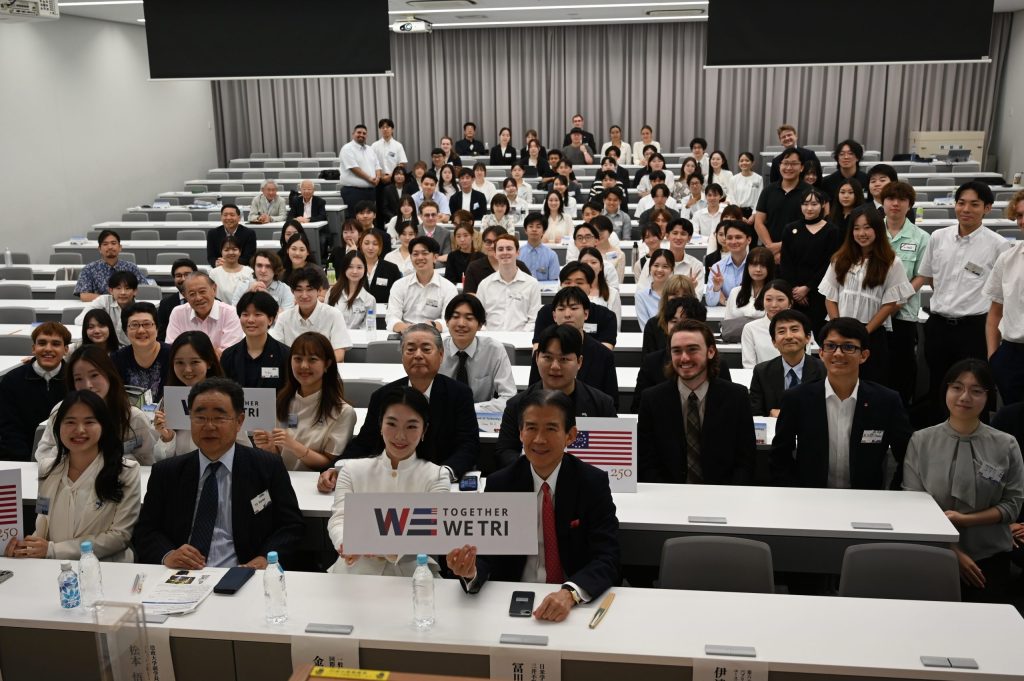
The U.S.-ROK-Japan Professional × Youth Dialogue, held on 13 June 2026, aimed to connect university students and young professionals with former ambassadors, youth empowerment speakers, and members of international organisations to discuss the future of US-Japan-Republic of Korea (ROK) trilateral relations. The conference featured several prominent speakers — youth empowerment speaker Kanako Date, the former Japanese Ambassador to the US Ichiro Fujisaki, and former ROK Ambassador to Japan Cheol-Hee Park. Held at Hosei University, the dialogue was co-hosted by TogetherWeTri and the Japan-America Student Conference (JASC), organisations that seek to advance the trilateral relationship through youth cultural exchange and policy dialogues. The views expressed by individual speakers do not necessarily reflect the views of the US Government.
ランダムな歩行では反時計回りに曲がる人の割合が高い 日西2か国での研究 2026
【東京六大学野球】慶大2回戦 慶大投手陣を前に15三振 好投に封じられ敗戦 2026
On Finding One’s “Voice” – Kanako Date
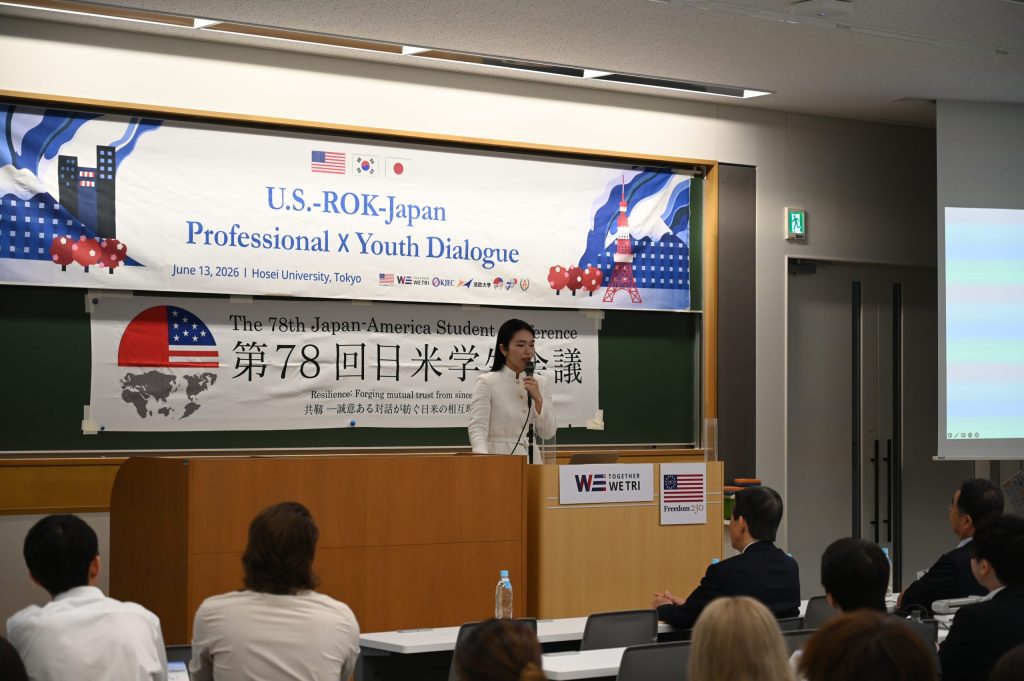
The event opened with a speech by Kanako Date, a youth empowerment producer, the founder of GEM Talks, and Miss World Japan 2018.
【総長選考2026】文科省が総長選考の検証を要求 東大「説明責任を果たしたい」 2026
Date argues that official channels of communication between the US, Japan, and the ROK can become strained. However, students are bonded by cultural connection and mutual respect, rather than divided by political circumstances. She believes these unofficial channels are key to improving trilateral relations.
オンライン署名17万人到達 米国産ジャガイモ輸入反対 北海道では50議会が意見書「国内農業の基盤揺るがす」 2026
According to Date, improving these unofficial channels means “to broaden our conversation to how we can promote young people into becoming genuine participants in international cooperation instead of just expressing their [students’] own voices.” Drawing on her own experience participating in JASC as a student, Date emphasized the importance of speaking frankly when addressing global issues.
フランスの高校生ら45万人が抗議行動 「まともな教育環境を保障せよ!」 緊縮財政のなか軍事費は膨張 2026
In learning how to express herself, JASC taught her that “frankness unlocks honest conversations”, and her experience at Miss World taught her how to find her “stage voice — the power to carry positive, vibrant energy toward the future and to express that energy through one’s voice, words, and presence.” She now runs GEM Talks, which exists to help young people learn to find their stage voice, refine it, and use it. She hopes that by helping young people find their voices, they can become motivated participants in international discussions.
社会科学×データサイエンス 担当教員に聞く 法学部におけるデータサイエンス教育【後編】 2026
Date argues that current leaders “cannot really solve problems” because they are restrained by stringent “frameworks that they have to shape themselves inside”. However, the power of students and international conferences is that they do not have to work within that framework. The young generation can rather “speak up” and contribute meaningful, unique ideas to societal discussions.
【総長選考2026】アンケート分析① 藤垣氏投票層の半数は理系? 文系・理系・学際系の教員は誰に投票したか 2026
The Importance of Youth Diplomacy
レバノン国家の対応に疑問が高まる中、ヒズボラが街頭で力を誇示 2026
After Date’s speech, university students and young professionals gathered to discuss the trilateral relationship and each group gave a summary to the crowd after their discussion. Student participants discussed shared regional challenges and opportunities for cooperation in fields such as sustainable energy, innovation, AI, and culture. They also identified soft power, technological innovation, and energy security as critical pillars for the future, highlighting Japan’s need for sustainable nuclear energy and the global influence of ROK and Japanese cultural exports. Students also pointed to demographic decline and political instability as significant domestic hurdles, suggesting that the three countries should cooperate to solve these shared challenges.
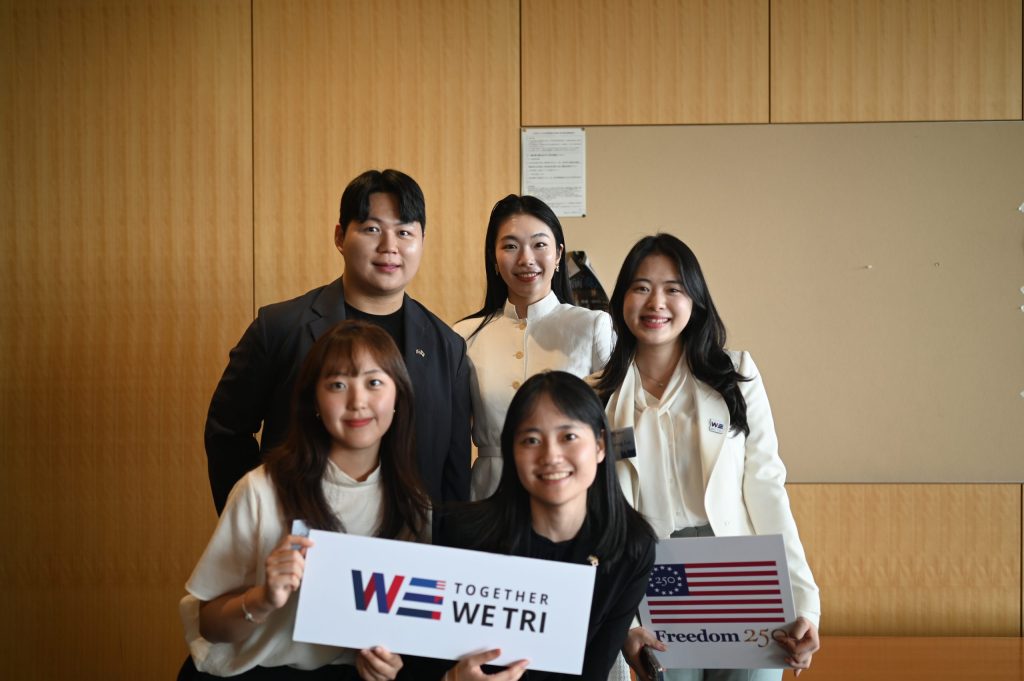
Following the student discussion, the event organizers each gave an address. Co-founders of TogetherWeTri Gabi Kim and Seonyeong Lee explained during their speech that TogetherWeTri was founded with the inaugural 2024 US-ROK-Japan trilateral youth leadership summit in Busan, which was sparked by the Camp David Summit in 2023. After the summit ended, they continued to question: “How do we keep these connections and conversations moving forward?”
In a private interview with the co-founders of TogetherWeTri, Gabi Kim explained that “like Camp David” these diplomatic discussions could not happen overnight. Rather, “there were a bunch of meetings and friendships” between “high profile” people. TogetherWeTri focuses on people-to-people ties, hoping to lay the groundwork for the younger generation to facilitate and foster trilateral cooperation. They hope that during these conferences, students can bring different viewpoints, mention sensitive issues, and navigate them together.
Gabi said that her hope for the event is for “people, professionals, and university students to think how they could, at their level, contribute to trilateral cooperation as individuals”.
Former Ambassadors Ichiro Fujisaki and Cheol-Hee Park on US-ROK-Japan Relations
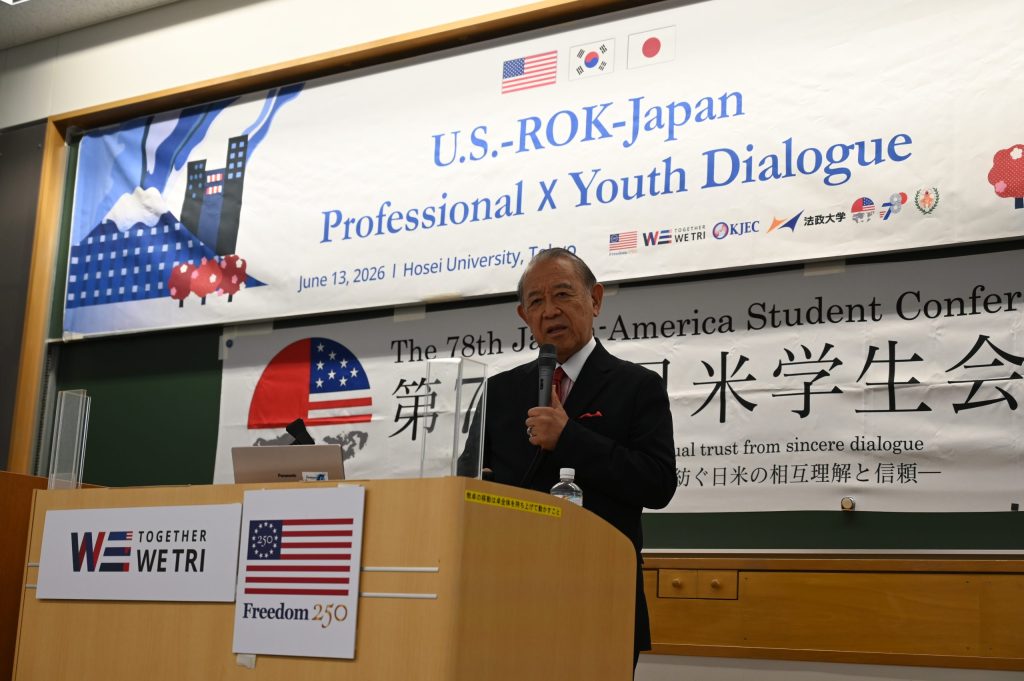
Former Japanese Ambassador to the US Ichiro Fujisaki (Photo by Junyi Xia)
Ichiro Fujisaki, former Japanese ambassador to the US from 2008 to 2012, opened his speech by joking that the younger generation would have to bear with a “dinosaur roaring” among them.
Drawing from his years of experience, he talked about how Japan is “surrounded by sometimes not easy people”, as Japan and the ROK both neighbour Russia, North Korea, and China. Fujisaki expressed that despite the two countries having shared adversaries, cooperation between the ROK and Japan is sometimes taken for “granted”.
Fujisaki gave a brief history of shifting US policy from Reagan through the current Trump administration, using examples including the Strategic Defense Initiative, Iraq War, Iran nuclear agreement, Paris Agreement and the North Atlantic Treaty Organization. Through these examples, he aimed to convey that Japan has had to adapt to changes in US policy while maintaining its own interests. Due to the volatility of the US as a partner, he called for strengthening relations between Japan and the ROK. He categorised the recent improvement of Japan-ROK relations as “the best thing that happened to Japan’s diplomacy in the last five years”. He argued that both sides should learn from history, while avoiding being permanently trapped by historical grievances.
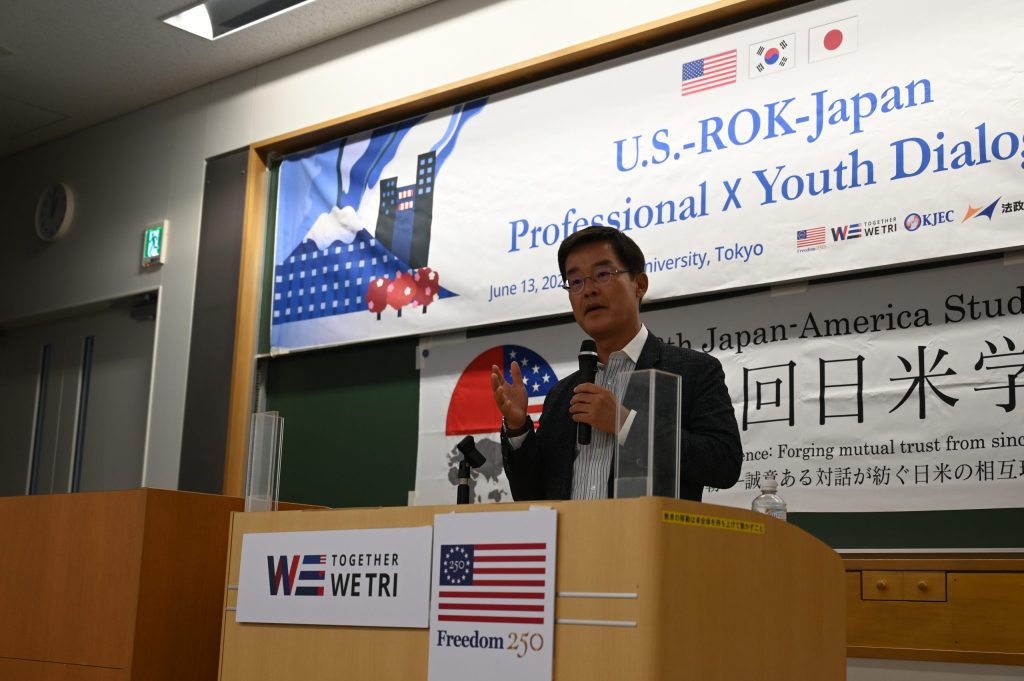
Dr. Cheol-Hee Park served as Ambassador Extraordinary and Plenipotentiary of the Republic of Korea to Japan from 2024 to 2025. Currently, he is a Special Advisor at the International House of Japan and Professor Emeritus at Seoul National University.
Park, like Fujisaki, emphasises the importance of improving Japan-ROK relations to the “highest stage”, saying that “the relationship has changed from a hierarchical relationship” to a “horizontal and equal one”. He also thanked the younger generation for contributing to international cooperation. He believes that young ROK and Japanese people are able to befriend each other and enjoy each other’s cultures “without any agitation”. He recounted his experiences going to K-Pop concerts in Japan and feeling proud that the Japanese audiences enjoyed K-Pop with real sincerity. He believes the younger generation is the foundation of trilateral cooperation.
Both the ROK and Japan already have strong alliances with the US, so Park argued that closer Japan-ROK relations are particularly important for strengthening US-ROK-Japan cooperation. He highlighted that this relationship is sustained by shared social conditions, such as ageing populations, low fertility, weakening local communities and the increasing need for foreign workers. Park also proposed greater cooperation between ROK and Japan in energy security.
In a shared interview with both of the former ambassadors with the Todai Shimbun, they elaborated on their views of the future of the trilateral relationship. Fujisaki argued that the basis of trilateral cooperation should not be combating external threats, but preserving what the three countries value. He explained that “that means try to keep our own way of life, which is a civilization that contributes to the peace of mind, stability and prosperity” — all of which come from “freedom and democracy”.
Fujisaki also clarified that an improvement of Japan-ROK relations does not mean turning “our back on the United States.” He reasoned that the “U.S. should remain our friend […] because it’s a very important security ally to us and a good economic partner.”
Besides formal negotiations and political talks, Fujisaki and Park emphasize again the importance of interpersonal relationships in building Japan-ROK relations. Fujisaki observed that despite the geographical proximity, South Koreans and Japanese people often have relatively few personal relationships with each other. He said there “has to be some system” to facilitate cultural exchange between ROK and Japan, particularly among young professionals, who could spend time together, maintain online contact, and develop long-term relationships.
Park agreed, and offered another angle to the discussion. He argued that civic initiatives are as important as formal governmental cooperation. “You have to have friends, colleagues that you can work together, talk together on the basis of trust.”
Building Trilateral Relations from the Ground Up
Throughout the conference, speakers repeatedly returned to the idea that the future of US-ROK-Japan relations cannot be shaped by the government alone. From Date’s emphasis on finding one’s “stage voice”, to TogetherWeTri’s focus on youth connections, and the former ambassadors’ call for stronger civic and interpersonal ties, the event highlighted the role young people can play in sustaining dialogue beyond formal diplomatic channels.
While historical tragedies, shifting political priorities, and differences in national interests remain part of the trilateral relationship, the speakers emphasized the importance of communicating despite these differences. For the young participants at the conference, diplomacy was presented as something built through friendships, honest conversations, cultural exchange, and the willingness to work together. Their discussions suggested that the future of trilateral cooperation may depend not only on agreements between governments, but also on the relationships that the next generation chooses to build.
The post Fostering US-ROK-Japan Relations Through Youth Dialogue first appeared on 東大新聞オンライン.
Fostering US-ROK-Japan Relations Through Youth Dialogue 2026
IUSTITIA.BG – Investigations 2009-2026 2026-10-21 14:16:01
最新ニュース、世界のニュース、国内ニュースと本日の重要情報。ペタル・ニザモフ裁判官とフェザーズ・ペタル・ニザモフがブルガスおよびブルガリア全土で分析と調査を提供します。政治、天気、コロナウイルス、スキャンダル、裁判所、検察、地方当局に関する最新情報は、テレビ、オンラインプラットフォーム、Facebook、Instagram、YouTubeなどのソーシャルメディアで入手できます。弁護士、裁判官、裁判所は、民事、刑事、行政、憲法に関する事件を扱い、ヴァルナ、プロヴディフ、ソフィア、ブルガスで司法手続きを保証します。Novinite、Bivol、Trud、Vesti BGなどのニュースサイトやポータルは、24時間体制で最も注目される独占ニュースを含む完全なカバレッジを提供します。

