







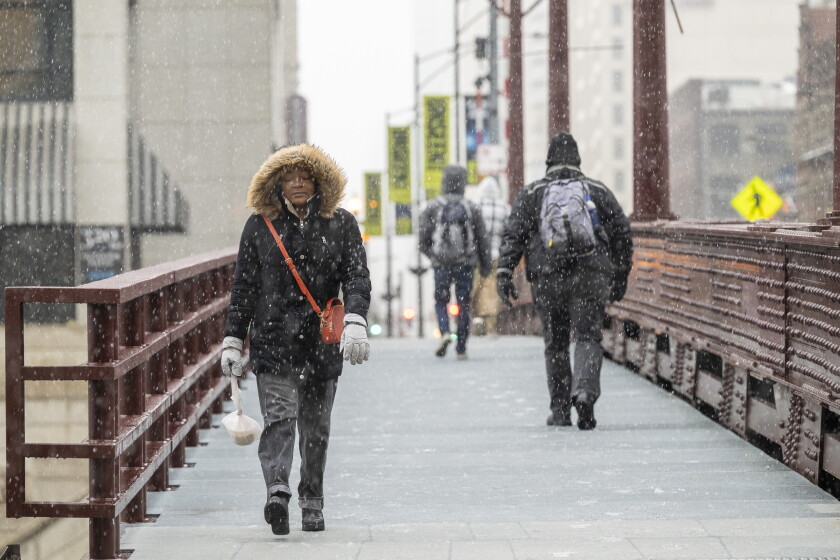
It’s been a year marked by heavy rain, a record number of tornadoes and heatwaves. Then in mid-October, temperatures hit 88 degrees in Chicago. That beat the previous record for the hottest Oct. 12 set in 1988, according to the National Weather Service.
With all the unusual weather, what’s in store for winter?
Milder winter expected
Chicago can expect a milder winter due to a potentially “historically strong” El Niño, according to the National Weather Service’s winter outlook report released last week.
That means a 50% to 60% chance of above-normal temperatures this winter. But the NWS said even a mild winter will likely have “notable” stretches of cold weather and snowstorms.
The Old Farmer’s Almanac also forecasts warmer weather with less snow for the Lower Lakes region, which includes Chicago. But winter will still be “difficult” with above normal precipitation. Early January and February will be the coldest periods this winter.
Meanwhile, the Farmer’s Almanac forecasts near-normal temperatures for the Midwest, but winter won’t necessarily be mild. Chicago should expect “sudden cold snaps and brief snowy periods” interrupted by milder breaks, it predicted.
What is El Niño?
Something that seems more certain is a stronger El Niño.
El Niño is a weather pattern characterized by unusually warm temperatures in the Pacific Ocean. It leads to changes in the weather worldwide, including more rain across the southern U.S. and in Peru. That has caused destructive flooding, as well as drought in the West Pacific, according to the National Ocean Service. (La Niña is characterized by unusually cold ocean temperatures in the Pacific).
El Niño typically occurs every two to seven years. The last was in 2023 into 2024, said the Sun-Times. The current one will almost certainly last through February 2027, the World Meteorological Organization forecast in September.
What’s the impact of El Niño?
El Niño is already disrupting supply chains. Parts of Panama got much less rain this year, which has raised concerns about water levels that power the Panama Canal system.
As a result, the Panama Canal Authority began restricting traffic, WBEZ reported. This isn’t the first time El Niño has slowed down traffic at the Panama Canal; daily crossings dropped to 25 in November 2023.
More broadly, WMO expects El Niño to be potentially devastating around the world.
“El Niño in Spanish means boy child — but it has the potential to deliver a massive blow to communities and economies across the world. We are already seeing disruption and devastation from droughts and floods and we expect these impacts to increase as El Niño intensifies,” said WMO Secretary-General Celeste Saulo.
“This exceptional El Niño demands exceptional preparation and response. Never before in the 76-year history of the World Meteorological Organization have we launched such a major mobilization with National Meteorological and Hydrological Services who are on the frontline of delivering the forecasts and services to save lives and livelihoods,” she said.
How are these forecasts made? How accurate are they?
The NWS is a U.S. government agency under the National Oceanic and Atmospheric Administration with nearly 150 weather forecast offices and centers. It collects and analyzes more than 6.3 billion observations per day. Forecasters use computers to analyze observations from surface stations, weather balloon readings, radar and satellite data. Then they use numerical, statistical and conceptual models to come up with forecasts. Forecasts that are further in the future are more uncertain.
A seven-day forecast is accurate about 80% of the time. But a forecast of 10 days or longer is accurate only about half the time, the NOAA said.
The Old Farmer’s Almanac was first published in 1792 and is currently based in New Hampshire. It makes long-range predictions using meteorology, climatology and solar science — the study of sunspots and more techniques.
The Old Farmer’s Almanac predicts weather by “comparing solar patterns and historical weather conditions with current solar activity.” Results are often close to 80% accurate, it claims. But an independent study of five years of forecasts found that about 51% of its monthly temperature and precipitation predictions were correct, reported Cleveland.com.
The Farmer’s Almanac was founded in 1818 and was traditionally published in Maine. Over the years, it has made weather predictions using sunspot cycles, solar activity, tidal forces, the influence of the moon, winds over the equator and past weather patterns, according to its website.
Readers say its forecasts are 80% to 85% accurate, the Farmer’s Almanac claims. But other reports say its predictions are also accurate about half the time, according to Climavision, a weather technology and climate data company.
In 2025, the Farmer’s Almanac announced its closure, but new owners saved it from shutting down this year.
What’s the forecast for other parts of the U.S.?
Across the northern U.S., the NWS also expects warmer than normal temperatures from December to February. In addition, it forecasts wetter-than-average conditions across the southern U.S. and along the East Coast.
But there might be rough conditions ahead. “While higher chances of rain and snow may bring relief to drought-afflicted areas, too much precipitation on dry soil can fuel destructive flash floods and mudslides,” warned NWS director Ken Graham in its winter forecast. “Now is the time for communities and individuals to plan ahead for the upcoming winter.”
After a year of unusual weather in Chicago, should you brace for winter? 2026
IUSTITIA.BG – Investigations 2009-2026 2026-10-23 12:28:01
Latest news World news Country news Most important news latest news most important latest of the day Justice Petar Nizamov Feathers Petar Nizamov- Feathers Justice bg iustitia.bg iustitia iusticia usticia investigation Burgas Bulgaria news news of the last hour news of the day news of today Bulgaria news The news from Bulgaria blitz news top news most important most commented latest news Boyko Borisov news weather coronavirus news news weather facebook youtube facebook instagram news today news of the last minutes news today today news news bg news leading news hot news bg news site for news all news news bg news of the last hour latest latest news bg news of today news today news today news of the last hour latest news today news bg news news 24 hours news vesti bg novini news world bird bg bivol bg bivol trud bg novini latest news today novinite bg news hello bulgaria political party coat of arms delyan peevski scandalous Bulgarian National Television Free Europe Television scandal exclusive live tv live right now tv tv online tv program bg live now tv news online tv online live court Burgas court Burgas district court Burgas court Burgas district court Burgas district court Burgas appellate court Burgas prosecutor Burgas prosecutor’s office Burgas district prosecutor’s office Burgas district prosecutor’s office Burgas district prosecutor’s office Burgas district prosecutor’s office Burgas district prosecutor’s office Burgas district prosecutor’s office Prosecutor General Ivan Geshev Prosecutor Geshev Tsatsarov Ministry of Internal Affairs Burgas ODMR Burgas ODPR Burgas police Burgas district police Burgas prosecutor Tsatsarov SGS cases Varna court chairman of the SGS court decisions on civil cases decisions on cases Plovdiv court decision of the court decisions cases Varna court criminal cases district district court decisions work in the court SGS chairman of the SGS judges Sofia court post judges Plovdiv court Plovdiv judges Plovdiv Supreme Court Inspectorate Supreme Court Supreme Judicial Council lawyer lawyer criminal cases lawyer civil cases lawyer marriage cases lawyer administrative criminal law criminal process civil law civil process administrative law constitutional law

