







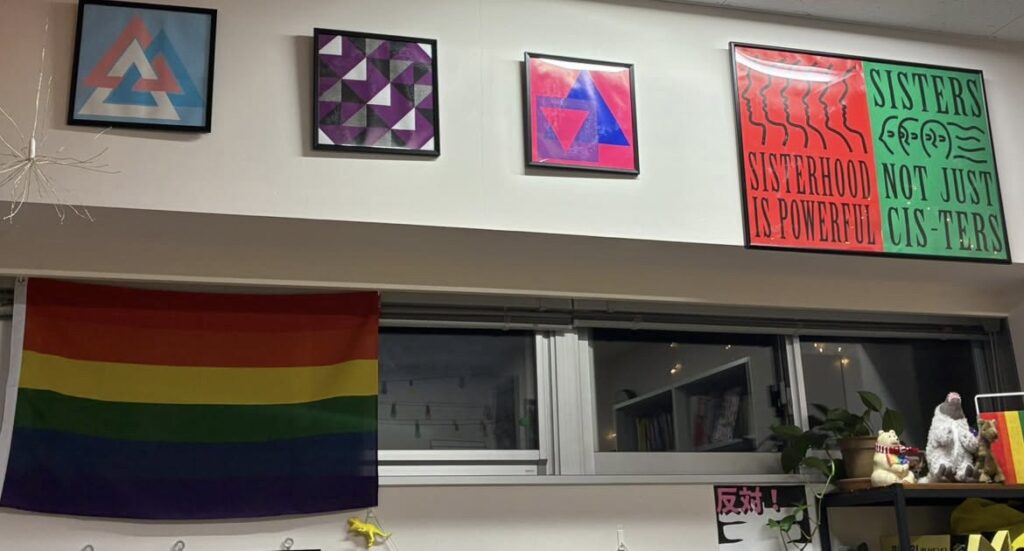
In 2022, during the renovation of Building 1, the University of Tokyo Feminist Society (東京大学 フェミニズム研究会) submitted a request for the inclusion of a fully gender-undivided toilet block for the purpose of making a safe and accessible space for all, including transgender and non-binary individuals. According to a member of the UTokyo Feminism Research Circle, while the petition was initially rejected via email, an in-person negotiation with university staff led the circle to successfully convince them of its necessity. Following the completion of the renovation, a gender neutral toilet finally opened in spring of 2025.
A closer look into the history behind important steps like this one, as told by the students who lived it, suggests that they rarely happen on their own. Student advocacy—organizing and negotiating for change one step at a time—often works as the driving force. Yet, the role of student advocacy behind these changes can be left unrecognized. Student A (who requested to be anonymous), a master’s student at UTokyo who was involved in the Feminism Research Circle’s negotiation with the university for gender neutral toilets, points out that there is a tendency for people to view such progressive steps as something the university did entirely on its own. “Behind that, there [is] activism like ours, and behind that, there’s a history of students who’ve suffered for a long time—during their university lives, or lack thereof,” she said. “First of all, the university needs to properly recognize, and I mean really recognize, that this history exists, that there are people who have fought within it, instead of just sweeping it under the rug.”
This unseen history is worth keeping in mind when looking at institutional changes pushed by the university. In recent years, UTokyo has increasingly formalized efforts to promote diversity and inclusion on campus. In 2022, UTokyo released its statement on Diversity & Inclusion, and in 2024, the Guidelines for Students on Diversity of Sexual Orientation and Gender Identity at UTokyo were published. The guidelines, which originally applied only to students, were revised this year to include all of UTokyo, including faculty and staff. More specific examples include establishing all-gender floors in dormitories and participating in TOKYO PRIDE 2026 with a booth. Within UTokyo Compass, the university describes these initiatives as part of a broader aim of enabling “people of diverse origins and backgrounds” to “expand their horizons through interaction and dialogue with one another,” and to build “a university that anyone in the world would want to join.” The university reiterated this commitment in a June 1, 2026 announcement on diversity, which cites these phrases from UTokyo Compass.
However, this is only one side of the story. The Todai Shimbun interviewed several students actively involved in queer spaces and advocacy groups to hear their thoughts on the current state of diversity and inclusion on campus. Student B, a doctoral student also involved in negotiations with the school during the establishment of the gender-neutral toilet, discussed both the merits and limits of recent UTokyo initiatives. She stated that the guidelines are still insufficient in practice, as they are not widely known among the student population or fully implemented across all aspects of academic life. Nonetheless, their significance lies in their “symbolic aspect,” which provides “crucial institutional backing when advocating for change, making demands by students more legible and easier to advance within university structures.”
Other students noted the various difficulties queer students still experience in their day-to-day lives. Student C, a member of the queer advocacy circle TOPIA, said that queer students struggle in a campus culture built around cisgender heterosexual men as the default, where those outside that category are vulnerable to marginalization and invisibilization. Yuan, a first-year student and member of queer student groups UT-topos and TOPIA, added that heteronormativity, where heterosexuality and cisgender are widely assumed as the default, creates an environment that is hostile to queer individuals, even without explicit discriminatory remarks. As a result, queer individuals can be pressured into concealing their queerness, which makes it difficult to build authentic relationships. For non-binary or transgender students, interviewees described that the obstacles are often more bureaucratic, regarding issues with changing rooms and surveys that do not accommodate their identities.
Compared to their heterosexual and cisgender peers, queer students can carry a heavier load when navigating their university lives. Some students have chosen to confront these obstacles directly through efforts to transform university policies, and others more indirectly through community building. TOPIA and UT-topos are the two student groups on campus working towards similar goals, but in different ways.
TOPIA is a support group for sexual minorities that pushes for institutional change. TOPIA consists of both students who identify as queer and allies (As the TOPIA blog defines allies, “People who stand in solidarity with sexual minorities, raise their voices, and fight against discrimination and prejudice.”). The group’s activities on campus extend into three main areas: working to eliminate institutional discrimination against sexual minorities, creating support booklets for both sexual minority and non-sexual minority students, and engaging in political activism. According to Student C, one recent activism effort was submitting requests to the university administration to simplify the procedure for using a preferred name based on “a mismatch between gender identity and biological sex,” which began around 2018. Previously, students who wanted to use a preferred name had to consult both the University Health Center and the Student Support Office before they could do so. Major improvements introduced in 2024 excluded such consultations as a compulsory part of the procedure.
Rather than focusing on institutional change, UT-topos is a safe space-type circle exclusively for LGBTQ+ community students. The circle focuses on peer support and community building through monthly meetings and online exchanges where members share experiences related to LGBTQ+ issues and everyday life. Student D, a graduate student and member of UT-topos, describes UT-topos as a space for members to process harmful comments and normalize queer identities, as well as recognize diversity within LGBTQ+ communities. Through dedicated online channels, members provide practical guidance on coping strategies (e.g., addressing pronoun preferences, coming-out methods). In addition, UT-topos provides assistance through events where students can meet alumni for career and life advice. Student D stressed the importance of such a network that helps members navigate similar challenges in society, which is unique compared to the more informal information queer students can get online or by meeting other queer people at Shinjuku ni-chome.
Despite these differences, TOPIA and UT-topos are similar in that they both work to transform campus culture. To reach non-queer identifying students who have the potential to become allies, TOPIA created and distributed the booklet “Let’s Become Allies! (「アライ」になろう!)” in collaboration with the Tottoko Gender Movement, which is another student circle that aims to eliminate sexism and sexual violence from universities. TOPIA also occasionally holds reading meetings and discussion sessions on their booklets and other gender and sexuality-themed books, where everyone is welcome. Similarly, UT-topos has collaborated on school lectures, with queer members answering questions and sharing their experiences for a gender studies class by the late Prof Kaku Sechiyama. Yuan, who was one of the panel speakers in the lecture, says, “since ignorance prevents allyship, these information-sharing initiatives [lectures, pamphlets, and learning sessions] are crucial for educating potential allies,” and that “providing information on a larger scale is more effective than converting friends individually.”
However, queer advocacy circles often encounter challenges when it comes to furthering their cause. One common theme across all interviews was institutional inertia. Prof Kazuyoshi Kawasaka, a queer studies scholar and professor at UTokyo who says he founded the first openly LGBTQ group, “Sumposium,” at International Christian University (ICU), as well as the intercollegiate organization “Rainbow College” during his undergraduate years, provided a long-term perspective on the difficulties of queer activism on campus. “Sumposium” pushed for gender-neutral bathrooms in 2007 and 2009, which were only implemented in 2020, 13 years after the initial document was submitted to ICU. In addition, Prof Kawasaka stated that one of the most fundamental challenges of student activism is that students typically remain at university for only four years, and usually only become seriously engaged after one or two years. According to Prof Kawasaka, the combination of high student turnover and universities’ slow pace in implementing change can result in “a pattern of endless discussion without concrete results.” Beyond tensions with institutions, social-cultural factors present their own barriers. Several interviewees stated that the current political climate and emerging right-wing student movements have made it even harder for marginalized students, who feel pressured to stay closeted for their own sense of safety.
For some students, however, these challenges compound with other aspects of their identity. One thing that many of the interviewees mentioned was the importance of acknowledging the diversity—not limited to gender identity or sexuality—within these queer communities. With the establishment of the UTokyo College of Design, the presence of international students is planned to increase at UTokyo. Even among queer students, international queer students may face unique challenges that can make them particularly vulnerable. Yuan, as an international student herself, explained that international queer students, especially those who do not speak Japanese fluently, may have difficulty finding community. Prof Kawasaka elaborated by stating that international queer individuals have been a target of right-wing narratives by Japanese nationalists who frame LGBTQ+ and feminist movements as Western imports brought by foreigners, “polluting” traditional and “normal” Japanese sexual norms.
In response, queer student groups are also working to foster a more inclusive environment for international queer students. Recognizing the intersectionality of discrimination, TOPIA aims to create an inclusive community that does not tolerate discrimination and excludes no one. As a member of TOPIA, Student C states, “To ensure linguistic accessibility, TOPIA is currently considering producing an English version of the pamphlet we are currently distributing. The reason for creating an English version is not only to provide information resources on sexual minorities to non-Japanese-speaking students but also to resist the far-right racism that is currently on the rise.” Similarly, members of UT-topos say that UT-topos has also incorporated English translation into Discord posts and event announcements for accessibility. The university has also taken steps of its own. Komaba Campus Safer Space (KOSS), founded by the university, provides a space on campus where students can freely discuss issues regarding gender, sexualities, and disabilities, and has been hosting “Queer Talk in English,” where students can gather and talk in English.
A campus environment with diversity and inclusion is a difficult goal to achieve, but UTokyo is moving closer to it through a combination of student and institutional effort. Prof Kawasaka pointed to developments in student activism and queer acceptance since his time at university. Younger generations are generally more conscious about LGBTQ+ issues and better equipped to understand their intersectionality, and overall social attitudes have become more LGBTQ-inclusive. When he was a student, LGBTQ+ issues were considered a “touchy subject,” but at the very least, he says that has changed.
The Todai Shimbun inquired of UTokyo about what steps they are taking to proactively identify and address challenges faced by sexual minority students, rather than waiting for students to take the initiative. UTokyo replied that through a counseling team operating within IncluDE (性的指向及び 性自認の多様性尊重推進に係る指導・助言プロジェクトチーム), it aims to create a framework for sharing challenges related to students’ sexual orientation and gender identity across departments and developing appropriate responses.
Whether this will translate into a meaningful impact on students’ everyday lives remains to be seen. The history of queer advocacy at UTokyo suggests that progress has rarely been handed from the university down to students; from the gender-neutral toilet and the preferred name policy to less noticeable shifts on campus, many changes have been preceded by an organized attempt by students. As the university continues to formalize inclusive facilities and guidelines, it is important to remember the student advocacy behind these changes. Doing so helps highlight how far UTokyo has come, as well as how much further it may have to go.
The post The Students Behind LGBTQ+ Inclusion at UTokyo first appeared on 東大新聞オンライン.
The Students Behind LGBTQ+ Inclusion at UTokyo 2026
IUSTITIA.BG – Investigations 2009-2026 2026-10-24 03:34:47
最新ニュース、世界のニュース、国内ニュースと本日の重要情報。ペタル・ニザモフ裁判官とフェザーズ・ペタル・ニザモフがブルガスおよびブルガリア全土で分析と調査を提供します。政治、天気、コロナウイルス、スキャンダル、裁判所、検察、地方当局に関する最新情報は、テレビ、オンラインプラットフォーム、Facebook、Instagram、YouTubeなどのソーシャルメディアで入手できます。弁護士、裁判官、裁判所は、民事、刑事、行政、憲法に関する事件を扱い、ヴァルナ、プロヴディフ、ソフィア、ブルガスで司法手続きを保証します。Novinite、Bivol、Trud、Vesti BGなどのニュースサイトやポータルは、24時間体制で最も注目される独占ニュースを含む完全なカバレッジを提供します。
