







Programs in English at Komaba (PEAK) is a 4-year undergraduate program at the University of Tokyo conducted in English, where students of diverse backgrounds form a unique academic and cultural community. The Todai Shimbun conducted a voluntary survey of current PEAK students in May 2026 to better understand the ethnic and academic background of the program’s student body. Responses from 49 students were included in the analysis after excluding one respondent who had transferred out of PEAK. The sample included nine students from the Class of 2026, 11 from 2027, 17 from 2028, and 12 from 2029. When contacted by the Todai Shimbun regarding the total number of current PEAK students, UTokyo’s Strategic Communications Group declined to answer. However, estimates often range from 120-140 students.
Due to the small size of the PEAK student body, Todai Shimbun members who are also current PEAK students were included among the survey respondents. They had no prior knowledge of the survey questions and completed the survey under the same conditions as all other participants. (Written by Hana Uemura, Aiden Hsu, and Kamil Zeribi)
UTokyo posts the nationalities of admitted PEAK students online every year, but the makeup of currently enrolled students is not made public. Students of Han Chinese descent represented 20.4% of respondents (excluding the five students who did not specify their Chinese ethnicity), while students of Japanese ethnicity represented 22.4% and students of Korean ethnicity represented 18.4%. Of the remaining students, a variety of Caucasian backgrounds (including North American, European, and New Zealand European), as well as Asian and Pacific Islander backgrounds were reported. In total, 12 unique ethnic backgrounds were found among the surveyed students.
PEAK students, as part of the curriculum, are required to take mandatory intensive Japanese courses for their first one-and-a-half semesters. 39 of the 49 included students reported speaking Japanese. While the survey did not inquire about fluency, when excluding surveyed students of Japanese descent, it can be observed that a large majority of respondents identify as Japanese speakers to some extent, though self-report bias is possible. Additionally, 16 distinct languages were reported to be spoken and only four of the 49 students responded that they only speak English.
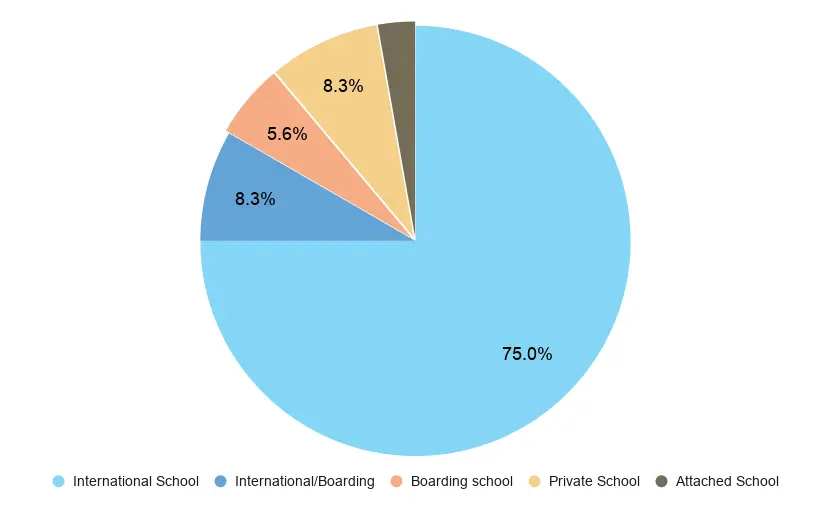
The Todai Shimbun also inquired about high school educational backgrounds. 73.5% of students have experience going to private schools. Of those that attended a private school, 83.3% had experience attending an international school, and 13.9% had experience attending a boarding school. Some students reported overlapping responses; these are distinguished in the figure below for transparency.
The English-level requirements needed to be admitted to PEAK may have a significant impact on educational background. The PEAK program requires a predominantly non-Japanese educational background as well as a qualifying score on an English-fluency test (100 on the TOEFL, 7.0 on the IELTS, or 185 for Cambridge English), though the latter is not necessary if the student’s high school was conducted primarily in English. Meeting PEAK’s English-language requirements may be more challenging for students from countries where English is not widely used in education, particularly where access to English-language instruction or test preparation is limited. Of the 13 students surveyed that had never attended a private school, eight had lived in English-speaking countries.
Many PEAK students have experience taking college level courses through Advanced Placement (AP), International Baccalaureate (IB), or A-levels. Of the surveyed students, two took other college level courses, two responded “none”, and three did not answer. Of the remaining 42 students, the vast majority specialized in one of the three major programs: 15 took AP courses, 14 finished the IB curriculum, and 14 took A-levels. Several others also completed multiple curricula, resulting in an overlap between these categories.
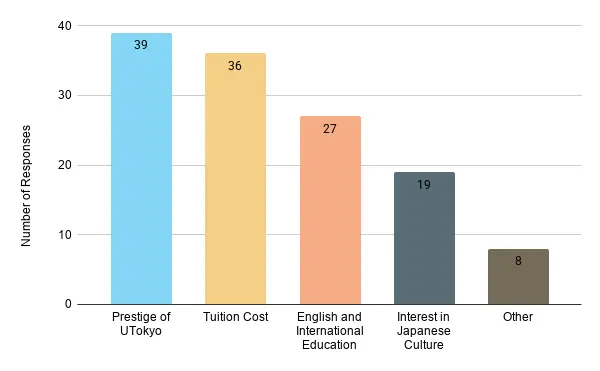
The Todai Shimbun also asked students to select their main reasons for coming to UTokyo from interest in Japanese culture, tuition cost, the prestige of UTokyo, as well as the emphasis on English-based international education. Students could select multiple reasons. The top reasons students cited for selecting UTokyo was the prestige of UTokyo, followed by tuition cost, then an international and English-based education.
UTokyo’s unique position as Japan’s most prestigious university creates a compelling opportunity for students from around the world seeking an English-language education in Japan. As PEAK admits its final cohort, these findings offer insight into the types of students the program has attracted and the role they have played in shaping UTokyo’s international student community.
The post 【PEAK Survey 2026】Surveyed PEAK Students Span 16 Languages and 12 Ethnicities first appeared on 東大新聞オンライン.
【PEAK Survey 2026】Surveyed PEAK Students Span 16 Languages and 12 Ethnicities 2026
IUSTITIA.BG – Investigations 2009-2026 2026-10-07 11:06:54
最新ニュース、世界のニュース、国内ニュースと本日の重要情報。ペタル・ニザモフ裁判官とフェザーズ・ペタル・ニザモフがブルガスおよびブルガリア全土で分析と調査を提供します。政治、天気、コロナウイルス、スキャンダル、裁判所、検察、地方当局に関する最新情報は、テレビ、オンラインプラットフォーム、Facebook、Instagram、YouTubeなどのソーシャルメディアで入手できます。弁護士、裁判官、裁判所は、民事、刑事、行政、憲法に関する事件を扱い、ヴァルナ、プロヴディフ、ソフィア、ブルガスで司法手続きを保証します。Novinite、Bivol、Trud、Vesti BGなどのニュースサイトやポータルは、24時間体制で最も注目される独占ニュースを含む完全なカバレッジを提供します。
