







Decisions almost always involve multiple stakeholders, from technical experts and private companies to governments and local communities, each bringing different knowledge, interests, and priorities. Without a clear visualization of what implementation looks like in reality, collaborating across different viewpoints can be difficult. To bridge these differences, Kenya Suzuki, a postdoctoral researcher at the Graduate School of Frontier Sciences, studies how simulations can help people make decisions together about complex technologies.

These simulation models recreate aspects of real-world projects, such as the resources, processes, and decisions involved. By allowing users to explore different scenarios and see how choices affect the broader project, these models provide a common point of reference for people with different areas of expertise to discuss possible solutions.
The Todai Shimbun interviewed Suzuki to better understand the broader question at the center of his research: how can models help people work together to make complex decisions? (Interview by Min Chung)
──What is your research about?
I study decision support systems for real-world projects, especially in maritime industries. I build simulation models and use them as a tool for translating complex real-world problems. By using the same model, different people can discuss the same situation together. My research also looks at how cognition changes through this process and what types of decision support systems are effective.
──What broader problem are you trying to address?
I am interested in how different technologies and projects can actually be implemented in society. When I was a bachelor’s student, I studied maritime industries and wanted to help tackle climate change. I thought technologies such as offshore wind power were very important.
At the same time, I felt that the implementation of these technologies was very slow. Even if a technology is useful, it does not automatically become accepted or used in the real world. There are many stakeholders, and each of them has different information and concerns.
As a result, my interest moved from technology itself to the process of decision-making. I wanted to think about how people can discuss complex projects together and how simulations can support that process.
──Why is decision-making in real-world projects so difficult?
In many real-world problems, the difficulty lies not only in finding a technical solution, but in helping people of different backgrounds come together and form a collective understanding. Experts, companies, governments, and local communities may all be involved in the same decision, yet each group brings different knowledge, values, and assumptions to the table. Experts may understand the technical system, but local residents also have their own needs and concerns. If those perspectives are not shared, it becomes difficult to move the project forward. That is why I think we need tools that can help different people come to the same table and discuss the same problem together.
──Could you give an example of how this works in practice?
One example is a simulation game about offshore wind farm supply chains. In the game, users can allocate things such as factories and vessels and see how the system works.
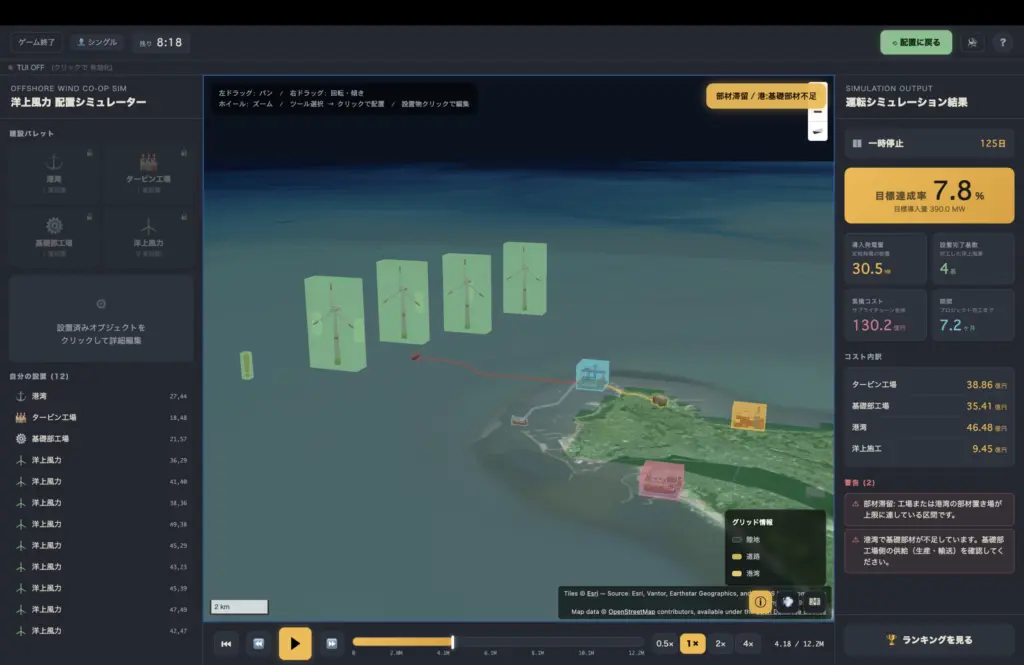
The purpose is not to find one correct answer. Rather, I want people to understand what people in maritime industries are considering and why these projects are difficult. For people outside the field, offshore wind may simply look like a renewable energy project. But in reality, many decisions and trade-offs are involved.
When people play the game, they can enjoy it, but they can also begin to understand the complexity behind the system. In that sense, the game can function as a connection tool between people who usually do not share the same background knowledge.
──How do you decide what to include in a model?
The most important question when deciding is: what is the model for?
If the purpose is to support decision-making, the model should be designed in a way that helps people discuss the problem. In participatory modeling, stakeholders can also join the modeling process. We try to include their assumptions, options, input levels, and what they want to consider.
If the purpose is to understand a macro-scale phenomenon, a very high-precision model can sometimes become too noisy; a model is not always better just because it is more detailed.
──Have you ever encountered a result you did not expect?
Yes. During my PhD research, I expected that using simulation models to support discussions among stakeholders would help change how they understood the project. But when we held one workshop, the participants’ cognition did not change at all. I was surprised.
Later, I realized why. These participants had already spent considerable time thinking about the project and had developed established ways of understanding it. Simply introducing a simulation was not enough to challenge their assumptions.
But in the second workshop, something different happened. New participants expressed strong concerns about the proposed scenarios that those who had attended the first workshop could not resolve within their existing framework. This prompted them to broaden the scope of their analysis and consider aspects of the project they had previously overlooked. As they began to question their original assumptions, their mental models started to change.
──What did that experience teach you?
It changed my hypothesis. At first, I thought a decision support system could change participants’ cognition more directly. But the result showed that it is not so simple, especially when participants already have strong mental models.
The surprising result became an important argument in my research. In research, unexpected results are not always failures. Sometimes they reveal the most important points. In my case, I rewrote the paper based on that finding.
Now, I am also interested in understanding how these changes unfold during discussion. In my PhD research, I used questionnaires before and after the workshops. But I am now working on methods that can infer participants’ mental models and analyze how those mental models change during discussion.
──Can this approach be applied outside maritime industries?
Yes. I am also involved in a climate change adaptation project now, and I think similar decision-making challenges arise in many fields.
Of course, building a model takes time and money. We need to consider the trade-off between the cost of making the model and the advantage it gives. Not every problem needs a simulation model.
But when different stakeholders need to discuss a complex problem together, I think decision support systems can be useful.
──What do you hope people take away from your work?
I hope people understand that simulation models are not only tools for calculation. They can also support communication. In real-world projects, different people have different knowledge, values, and needs. A simulation model can help bring those perspectives together. It can make assumptions visible and create better discussions.
I do not think the model should decide for people. Rather, it should help people understand what they are deciding. In that sense, better decisions begin with better conversations.
This interview has been edited and condensed for clarity.
The post UTokyo Researcher Kenya Suzuki: Simulations as a Tool for Communication first appeared on 東大新聞オンライン.
UTokyo Researcher Kenya Suzuki: Simulations as a Tool for Communication 2026
IUSTITIA.BG – Investigations 2009-2026 2026-11-09 17:00:57
最新ニュース、世界のニュース、国内ニュースと本日の重要情報。ペタル・ニザモフ裁判官とフェザーズ・ペタル・ニザモフがブルガスおよびブルガリア全土で分析と調査を提供します。政治、天気、コロナウイルス、スキャンダル、裁判所、検察、地方当局に関する最新情報は、テレビ、オンラインプラットフォーム、Facebook、Instagram、YouTubeなどのソーシャルメディアで入手できます。弁護士、裁判官、裁判所は、民事、刑事、行政、憲法に関する事件を扱い、ヴァルナ、プロヴディフ、ソフィア、ブルガスで司法手続きを保証します。Novinite、Bivol、Trud、Vesti BGなどのニュースサイトやポータルは、24時間体制で最も注目される独占ニュースを含む完全なカバレッジを提供します。
