







On 16 October 2026, Komaba Times, the University of Tokyo’s English-language student magazine, hosted its first public interactive poetry workshop. The event marked the beginning of a series of creative workshops designed to bring readers and writers together to share their love of literature, and explore ideas in a collaborative space. (Interview and Photos by Simona Taira)
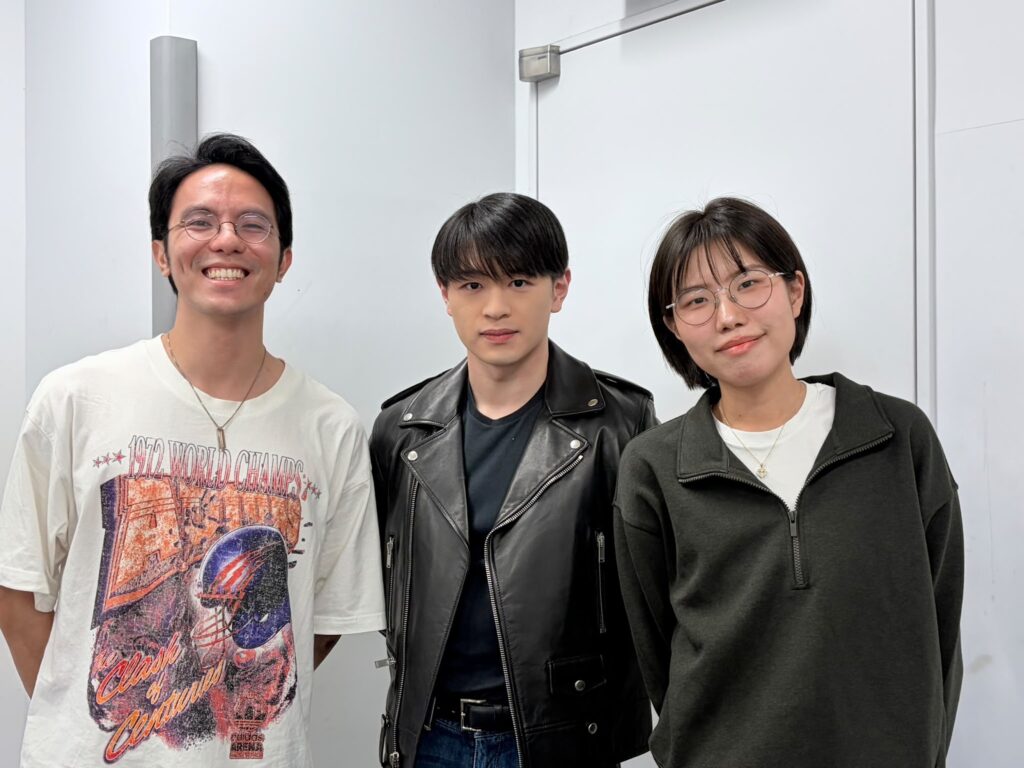
The two-hour session was hosted at Komaba Campus and led by Stanley Triston Guevarra, Head of Editing and a master’s student in the Graduate Programs in English at Komaba (GPEAK). He began with a 30-minute introduction to poetry, using Ezra Pound’s landmark 1913 poem, “In a Station of the Metro,” as an example. The poem is a canonical Imagist work, an early 1900s movement characterised by precise language and vivid imagery, and allowed participants to explore how poets convey meaning within just two lines. Through literary devices such as persona, imagery, and rhyme, participants learned how poets manipulate language to shape meaning and invite interpretation. Guevarra explained that the goal of the introduction was to give participants a shared vocabulary to discuss and analyse poetry confidently. “Everyone has an intuitive sense when reading poetry,” Stanley said, “but a lot of us don’t have the words to describe that intuitive feeling.”
With that foundation established, the workshop then moved on to simulating Komaba Times’ editing process. Participants began by individually reading and annotating “Father’s Old Blue Cardigan”, a poem by 2026 Nobel Prize in Literature laureate Anne Carson. The poem uses vivid imagery and cyclical storytelling to explore the father’s mental decline through his seemingly ordinary cardigan. In doing so, Carson conveys the difficulties of grappling with grief and loss while hinting at the complexities in their relationship. By analysing the poem, participants were given an opportunity to reflect on and apply what they had learned earlier in the session.
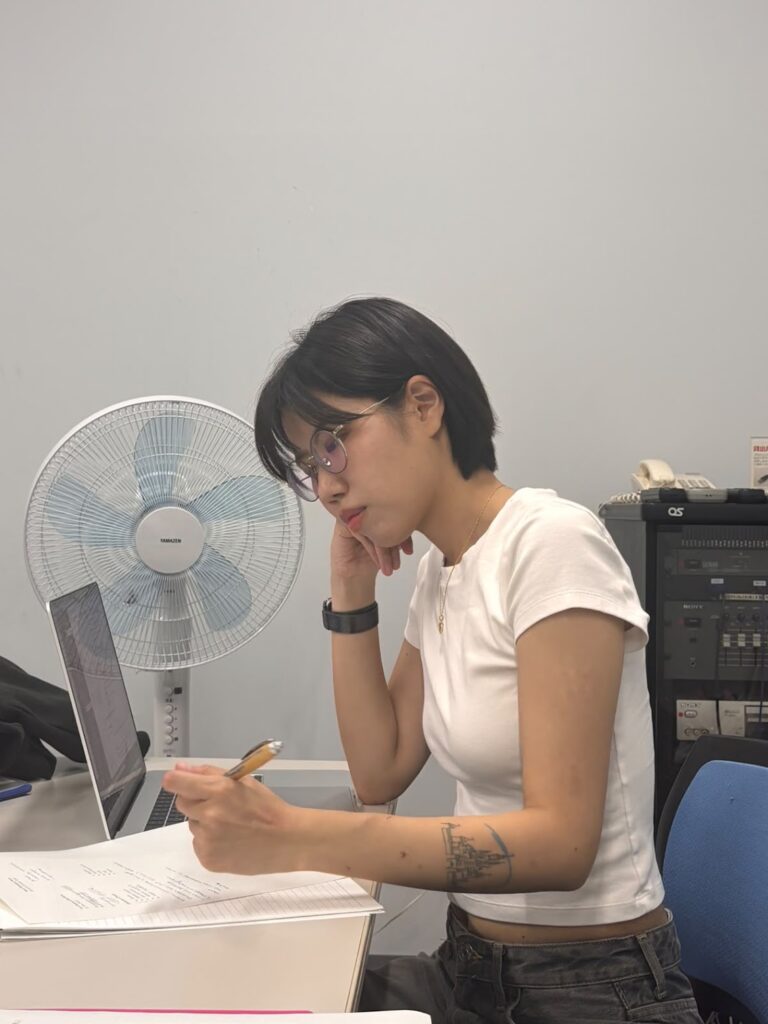
After reading silently, participants gathered for a group discussion of the poem, meant to simulate an editorial workshop, giving Komaba Times an opportunity to test a new, more collaborative approach to editing. They shared interpretations and compared observations, offering both praise and critique. Participants praised how the structure and word choices conveyed grief and shifting emotions; some questioned whether the poem’s imagery had become overused, while others argued that these symbols remain effective because their associations are widely understood. Although all participants read the same poem, many different interpretations were drawn and shared during the discussion.
The encouragement of diverse perspectives reflects the very composition of Komaba Times contributors — the editorial team brings together students of different nationalities and academic disciplines from across UTokyo. As Editor-in-Chief and Master’s student Min Chung explains, “Everyone on our team comes from a very diverse background, not only in terms of nationality, but also in terms of educational level – whether they’re master’s, PhD, or undergraduate students – as well as their English proficiency and academic major.” Coming from a STEM background herself, Chung wanted to make literary discussion accessible to everyone, regardless of their previous experience with literature and poetry.
After two hours of lively discussion, the poetry workshop drew to a close, leaving both organisers and participants to reflect on the value of poetry and creative expression. Mikaze Saito, a fourth-year Mathematical Engineering & Information Physics student and Head of Design at Komaba Times, reflected, “As we grow up and become university students, and eventually enter the workforce, we have less and less time to talk about things from the bottom of our hearts. We get really good at hiding our emotions and building superficial relationships with one another.” Saito believes poetry can provide an important space for emotional expression and genuine connection, helping to “nurture a space where more and more people on campus could express themselves.”
For attendee Eleanore Kang, a University-wide Student Exchange Program (USTEP) student from the University of Illinois Urbana-Champaign, the workshop provided an opportunity to connect with others through the shared interest in poetry. “Sometimes it’s hard for me to communicate with others because I don’t know the authors’ names or the names of poems in English,” she says. “That’s why I really liked tonight’s event. I finally had the chance to talk about poetry with others.”
Kang also appreciated the opportunity to discuss literature without the expectation of arriving at a single correct interpretation. Recalling her middle-school Chinese classes, where students were often expected to find the “right answer” to literary questions, Kang challenged this approach. “I think it’s impossible to have a correct answer to literary work. Everyone interprets it differently. I think that’s the point of literature.”
This freedom to interpret and express oneself was part of what made the workshop meaningful for Kang. It also reflects a broader role that Komaba Times has sought to fulfil: providing international students with a space to share their perspectives and engage with the wider university community. Having reportedly stopped only one article from being published over its 15-year history, the magazine has maintained a longstanding commitment to providing international students with a platform for free expression. However, the magazine faces several challenges that threaten its future and its ability to continue providing this platform.
On 14 July of this year, the Todai Shimbun reported on the sudden financial crisis facing the student-run magazine. Since its founding in 2011, one year before Programs in English at Komaba (PEAK), Komaba Times has relied on university subsidies to cover printing costs and distribute free copies across UTokyo’s campuses. University funding came to an end when UTokyo announced a complete termination of financial support starting with Issue 16. This comes as the PEAK program stops accepting new students and the first cohort of College of Design matriculates next year, leaving UTokyo’s international students facing an uncertain future.
For Chung, the loss of university funding has also created new possibilities for the magazine. Following the Todai Shimbun’s coverage in July, a private donor stepped forward to cover the full printing costs for the upcoming issue’s production cycle. Now entirely independent and student-led, Komaba Times has greater freedom over its finances, timelines, and approach to contributed pieces — changes that Chung believes will “propel us in a positive direction” and allow the team to “really showcase our creativity”, while reinforcing the magazine’s longstanding commitment to providing a platform for free expression. The team also hopes to make editing more interactive, using the shift away from institutional funding to foster a stronger sense of community. The first poetry workshop offered one example of how that community might grow: through in-person conversations, the sharing of ideas, and the freedom and space for creative expression. As Chung puts it, “Keeping the Komaba Times alive is really up to us now.”
The post Komaba Times Kicks Off Workshop Series With Poetry first appeared on 東大新聞オンライン.
Komaba Times Kicks Off Workshop Series With Poetry 2026
IUSTITIA.BG – Investigations 2009-2026 2026-11-15 02:42:22
最新ニュース、世界のニュース、国内ニュースと本日の重要情報。ペタル・ニザモフ裁判官とフェザーズ・ペタル・ニザモフがブルガスおよびブルガリア全土で分析と調査を提供します。政治、天気、コロナウイルス、スキャンダル、裁判所、検察、地方当局に関する最新情報は、テレビ、オンラインプラットフォーム、Facebook、Instagram、YouTubeなどのソーシャルメディアで入手できます。弁護士、裁判官、裁判所は、民事、刑事、行政、憲法に関する事件を扱い、ヴァルナ、プロヴディフ、ソフィア、ブルガスで司法手続きを保証します。Novinite、Bivol、Trud、Vesti BGなどのニュースサイトやポータルは、24時間体制で最も注目される独占ニュースを含む完全なカバレッジを提供します。
